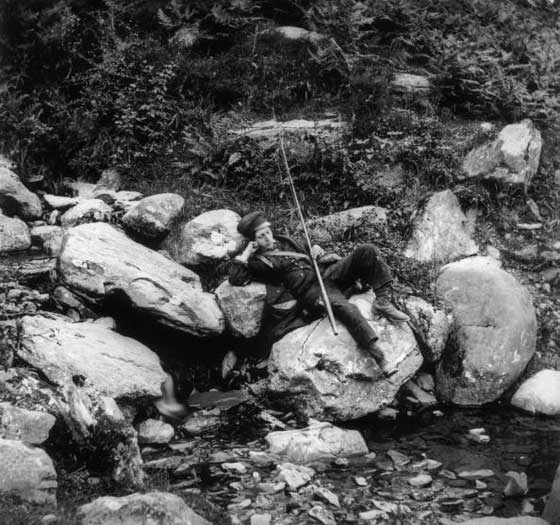
Leaning back on a pile of river-worn boulders, the fisherman has turned his outing into a quiet nap, rod still angled upward as if duty might continue on its own. The rocky bank fills the foreground with smooth, pale stones, while low brush and darker foliage press in behind him, making the scene feel tucked away from any road or crowd. It’s an understated comic moment: patient sport meets a perfectly timed bit of human fatigue.
The title, “Napping while fishing, 1857,” hints at how familiar this joke would have been even in the mid-19th century—waiting can be the longest part of angling. His relaxed posture and loosely held line suggest that the day’s goal may have shifted from catching supper to simply escaping routine for a few peaceful hours outdoors. Details in clothing and gear reinforce the everyday character of the scene, more about leisure and endurance than heroics.
As a piece of early outdoor photography, the image doubles as a small document of how people used rivers and streams for recreation, rest, and a change of pace. The composition draws the eye along the water’s edge and across the scattered stones, emphasizing texture and terrain as much as the sleeping figure. For readers searching for historical fishing photos, 1850s leisure culture, or the timeless humor of “just waiting for a bite,” this snapshot-like moment delivers both atmosphere and charm.