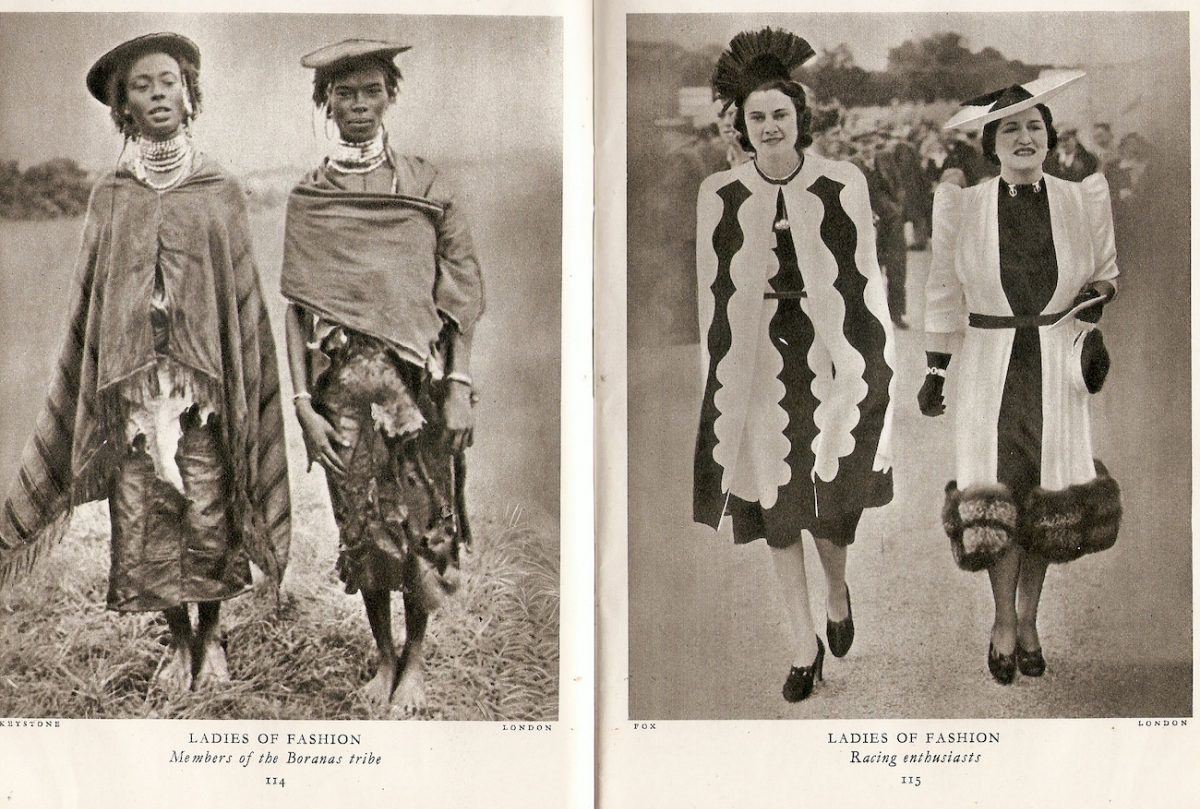
A striking two-page spread titled “Ladies of Fashion” sets up an intentional contrast: on one side, two members of the Boranas tribe stand outdoors in layered wraps, beadwork, and distinctive head coverings; on the other, two racing enthusiasts walk toward the camera in tailored coats, dramatic hats, and carefully styled accessories. The juxtaposition feels like an early lesson in how photographs and captions could frame “fashion” as both everyday identity and public performance, depending on who is being viewed and who is doing the viewing.
Clothing details draw the eye immediately—the texture of draped fabric and jewelry on the left, the bold patterned coat and cinched silhouettes on the right—each presenting a different vocabulary of status, practicality, and style. The editors’ pairing invites comparison, yet it also reveals the period’s habit of turning people into categories: “tribe” as ethnographic curiosity, “racing” as modern leisure. Even without a precise date or place stated here, the page layout and language echo a time when magazines and illustrated features loved neat contrasts, even when real lives were more complex.
Beyond the “funny” premise, the image works as a compact artifact of visual culture, showing how fashion history has often been written through selective framing and confident labels. It’s ideal for readers interested in vintage photography, colonial-era publishing, social history, and the evolution of women’s dress—from rural settings to the spectacle of the track. Look closely and the story becomes less about who is “more fashionable,” and more about how a camera, a caption, and an editor’s idea can shape what audiences think they’re seeing.