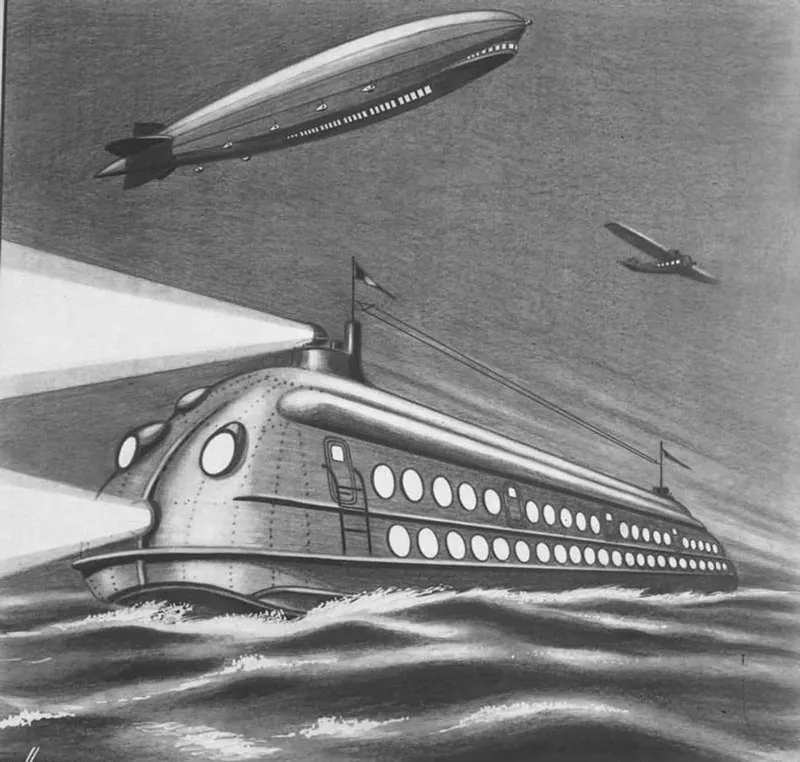
Optimism hums through this 1931 vision of the year 2000: a streamlined “express ocean liner” that looks less like a traditional ship and more like a machine built for pure velocity. Its rounded prow cuts into choppy seas, while long rows of circular portholes suggest crowded decks of modern travelers, all sealed inside a smooth, aerodynamic hull. The artist even gives the vessel a sense of scale and spectacle—searchlight-like beams rake the air as if the ship were part ocean steamer, part floating city.
Above the waves, sleek airships drift through the sky, turning the scene into a fully imagined transportation network where sea travel and flight share the same horizon. The composition sells a future where intercontinental journeys feel coordinated, engineered, and almost effortless, with technology not merely improving comfort but redefining what a “liner” could be. Details like antennas, railings, and the glossy curvature of the superstructure echo the era’s fascination with speed, metal, and the promise of modern design.
As a piece of retrofuturism, the image is funny in the way many old predictions are funny: not because the creators lacked imagination, but because their imagination was anchored to the shapes and hopes of their own time. The 1930s loved streamlining, believed in heroic engineering, and expected tomorrow to arrive as a cleaner, faster version of today—one dramatic silhouette at a time. For anyone drawn to historical futurism, vintage sci‑fi aesthetics, or the history of ocean liners and airships, this illustration is a perfect time capsule of what the year 2000 was “supposed” to look like.