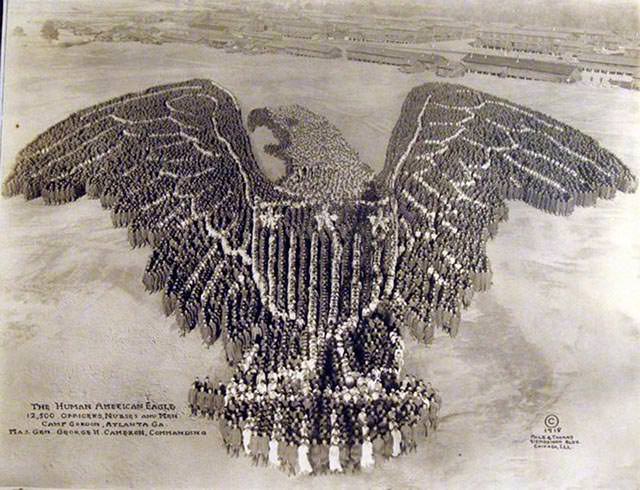
From high above the parade ground, thousands of uniformed figures lock into place to create a striking emblem: an American eagle with wings fully spread. The title tells us this was a carefully staged formation at Camp Gordon in 1918, bringing together officers, nurses, and soldiers into a single coordinated display. Rows of bodies become feathers and shadows, turning military drill into a piece of living graphic design.
The composition works because of its sheer scale and precision, with the dark massing of uniforms defining the eagle’s outline while lighter gaps carve out the head and the layered patterning in each wing. In the distant background, long low buildings and open training land hint at the size of the camp itself, reinforcing that this was a place built for mobilization and routine. It’s both orderly and theatrical, suggesting a moment meant to be witnessed, photographed, and remembered.
As a World War I-era photo, the “human eagle” reads like patriotic spectacle as much as military documentation—an image designed to communicate unity, discipline, and national identity in one glance. For readers searching for Camp Gordon history, 1918 military training imagery, or early examples of mass formations and propaganda photography, this scene offers a vivid entry point. The result is oddly moving: individual people disappear into the symbol, yet their collective presence is what makes the symbol possible.