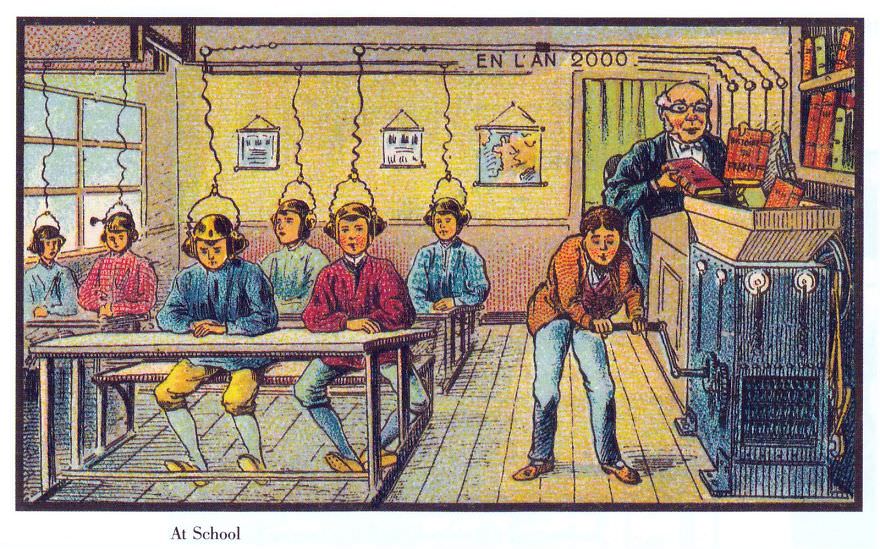
Under the banner “EN L’AN 2000,” a classroom of the future is imagined with children sitting at long desks, each wearing bulky headsets tethered by wires that hang like light fixtures. The students stare forward in near silence, as if learning has been reduced to listening, while books and maps linger on the walls as familiar relics. The scene reads like a playful prophecy: education streamlined into an audio feed, with the printed page demoted to background decor.
Off to the right, a stern-looking adult oversees a hulking machine—part cabinet, part engine—with dials, vents, and a feed tray that accepts a stack of books. One child strains at a hand crank, supplying the labor to keep the apparatus running, a sly reminder that “automation” often still needs human effort somewhere in the system. The cartoonish technology exaggerates the mechanics, but the idea is strikingly modern: converting textbooks into sound so lessons can be delivered through headphones.
Seen today, this historical illustration feels both funny and eerily familiar, echoing everything from audiobooks and text-to-speech to classroom headphones and adaptive learning tools. Its charm lies in the tension between optimism and satire—promising effortless study while hinting at monotony and control. For anyone interested in the history of educational technology, early futurism, and the long dream of machines that automatically convert textbooks into audio, this image offers a vivid window into how people once pictured tomorrow’s schoolroom.