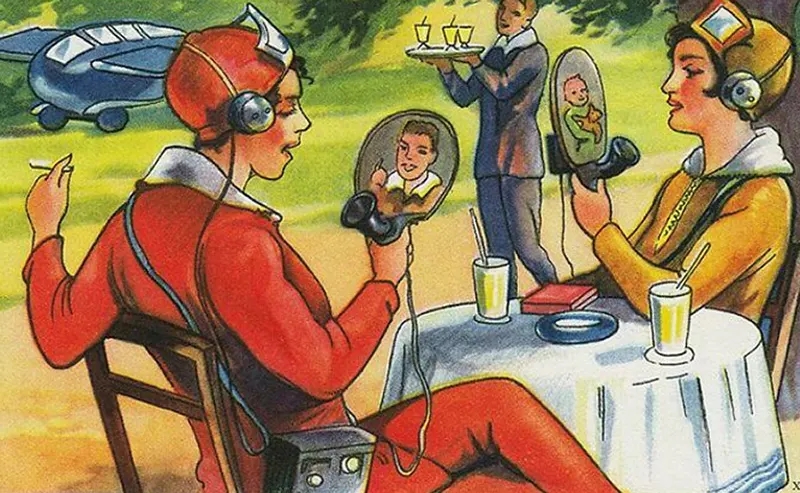
A pair of stylish diners sit at a small café table, chatting not face-to-face but through handheld video screens connected by trailing wires and bulky headsets. The artist’s 1930 vision of “the future” swaps conversation for telepresence, complete with rosy-cheeked portraits framed like miniature televisions. Even the setting feels like a gently comic prophecy—an ordinary meal made extraordinary by gadgets that demand as much attention as the people using them.
Across the tablecloth, the details do the storytelling: a compact box slung at the waist like a portable power source, a server balancing a tray while the patrons stay glued to their screens, and tall drinks waiting patiently beside a couple of stacked books. In the background, a sleek, streamlined vehicle hints at a world where speed and modern design are taken for granted. The scene leans into optimism, yet it also winks at the idea that tomorrow’s conveniences might make social life look slightly absurd.
Viewed today, this futuristic illustration reads like an early meditation on video calls, wearable tech, and the perennial promise that new devices will bring us closer. It’s funny in the way good historical art often is: not because it’s “wrong,” but because it reveals what people in 1930 hoped, feared, and expected from modern technology. For anyone drawn to retro futurism, 1930s predictions, and vintage visions of the future, this image offers a vivid snapshot of yesterday’s tomorrow.