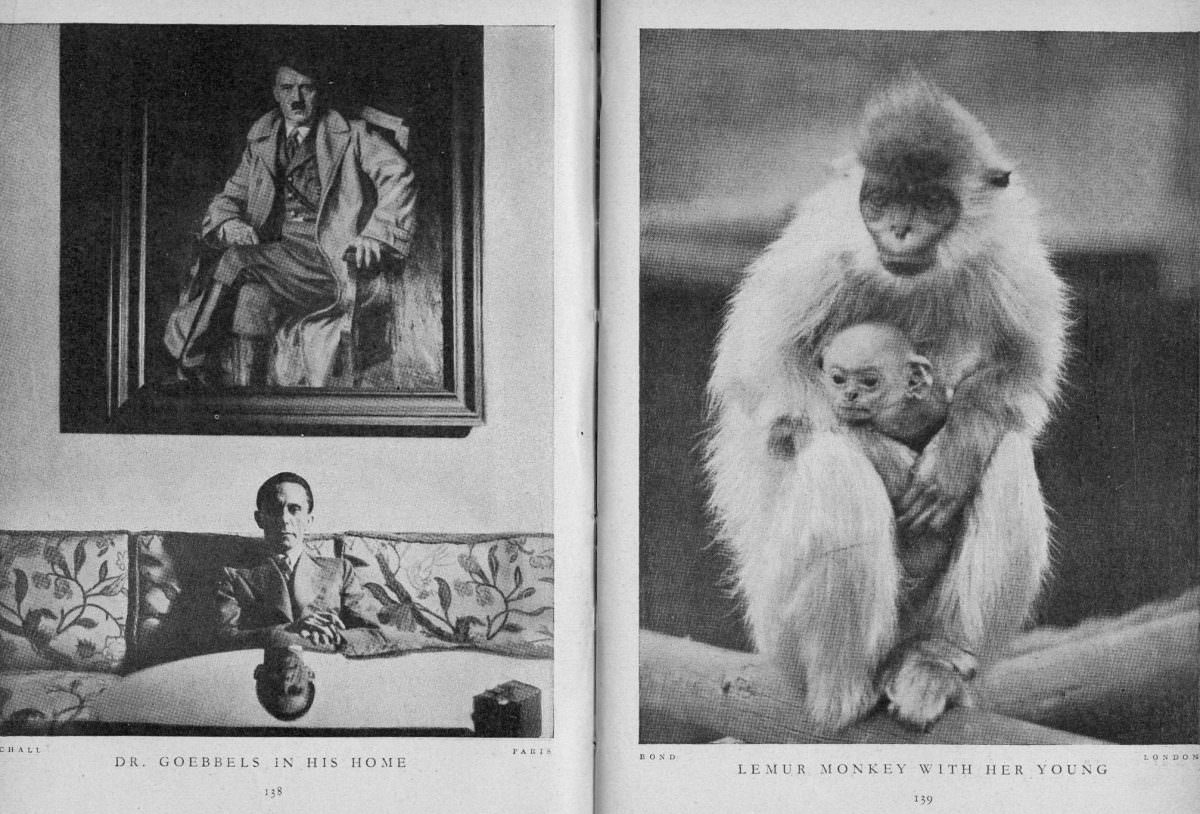
An open book spread places two very different worlds side by side: on the left, “Dr. Goebbels in his home,” seated stiffly on a patterned sofa beneath a large framed portrait; on the right, a lemur monkey crouches protectively with her young. The domestic interior—table, upholstery, and carefully arranged wall art—suggests a deliberate effort to present respectability and control within a private setting. Even in this quiet room, the composition feels staged, as if the camera is invited to reassure rather than to reveal.
Across the gutter, the animal photograph shifts the mood entirely, trading political theatre for instinct and tenderness. The mother’s long fur frames the infant’s small face, and the pose reads as sheltering and intimate, a snapshot of dependence that needs no caption to be understood. Seen together on the same printed page, the pairing has an odd, almost surreal rhythm: human self-presentation versus the unvarnished language of care in the natural world.
For readers browsing historical photo archives, this juxtaposition is a reminder of how illustrated publications curated meaning through contrast as much as through content. The title alone draws attention to the uneasy blend of “home life” imagery with the everyday charm of animal photography, a mix that could entertain while also normalizing what sat nearby. If you’re searching for “Dr. Goebbels in his home” or “lemur monkey with her young,” this post preserves the page as an artifact of visual storytelling—how history was packaged, captioned, and consumed.