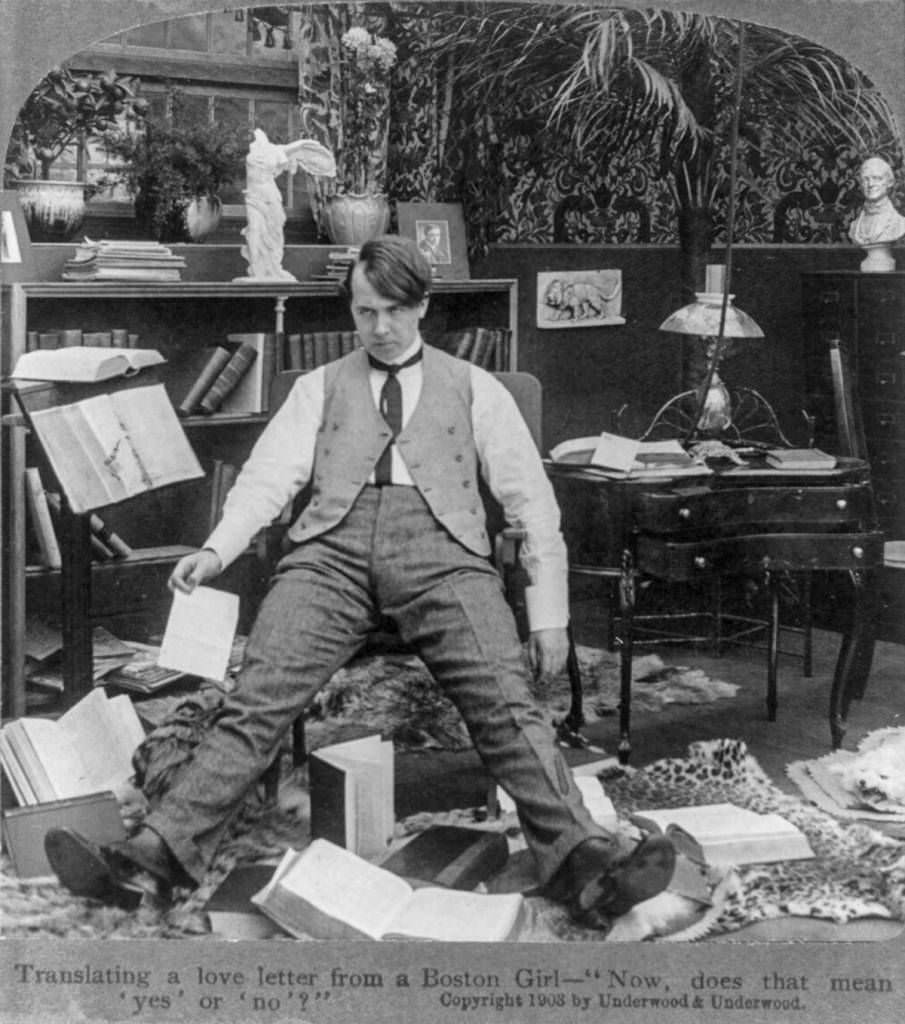
A rumpled young man slumps in a chair, legs stretched wide, staring straight at the camera with the weary look of someone losing an argument to ink and paper. Around him, books spill from a case and lie open across the rug as if he’s been searching every volume for a single, decisive answer. In one hand he holds a letter—presumably the “love letter from a Boston girl”—and the whole scene reads like a staged moment of comic despair: scholarship versus sentiment.
Behind the clutter, the setting feels like an early-1900s study, crowded with details that suggest both learning and performance: a desk lamp poised over paperwork, shelves lined with hardbacks, potted plants, and small artworks and statuary that lend a cultured, parlor-room atmosphere. The contrast is the joke—this tidy world of knowledge is no match for the slippery language of affection, where a phrase can be read as either promise or polite refusal. Even without seeing the letter’s contents, the posture and mess make the punchline clear: translating feelings is harder than translating words.
Titled “Translating a Love Letter From a Boston Girl – Now Does That Mean ‘Yes’ or ‘No’?” (1903), the photo leans into the era’s fascination with witty captions and everyday romance as a public spectacle. It’s a charming snapshot of courtship before texting and emojis, when a delayed reply and ambiguous phrasing could send a reader into full-blown analysis. For anyone interested in Boston history, turn-of-the-century humor, or vintage love letters, this image offers a playful reminder that uncertainty has always been part of the love story.