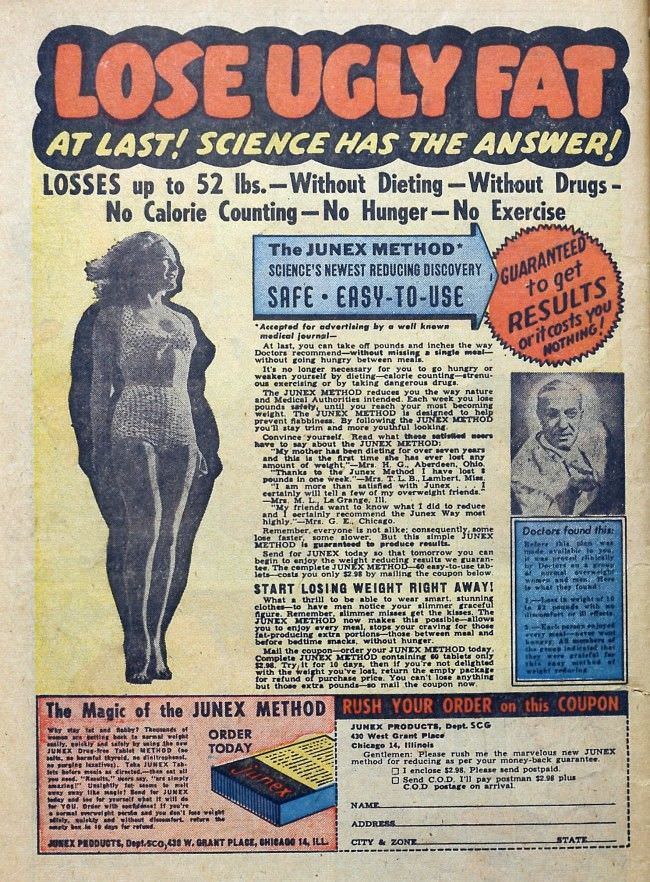
Loud, blunt, and impossible to ignore, the headline “LOSE UGLY FAT” sells more than a product—it sells a worldview. The ad leans hard on the era’s fascination with “science” as a miracle cure, promising dramatic weight loss “without dieting,” “without drugs,” and even “no exercise,” as if modern life could be fixed with a single mail-order answer. That kind of hyperbolic copy makes this a sharp artifact of vintage dieting culture and the language of body shame in mid-century advertising.
Beneath the shouting typography, the layout does what classic print ads did best: overwhelm the reader into compliance. Bold claims, a “safe, easy-to-use” method, a guarantee stamp, and dense blocks of persuasive text form a familiar sales funnel, capped by a tear-off coupon designed to turn insecurity into immediate action. Even the illustrations and boxed testimonials are arranged to feel like evidence, borrowing the look of authority to give emotional marketing a scientific sheen.
Humor bubbles up today because the pitch is so overconfident, yet it also exposes a lasting contradiction hinted at in the post title: when is fat treated as a flaw, and when is it repackaged as “glamour”? This historical photo is a useful window into old-school weight-loss advertising, diet industry promises, and the way beauty standards were enforced through copywriting. For anyone researching vintage magazine ads, body image history, or the evolution of “too good to be true” health marketing, it’s an uncomfortably revealing read.