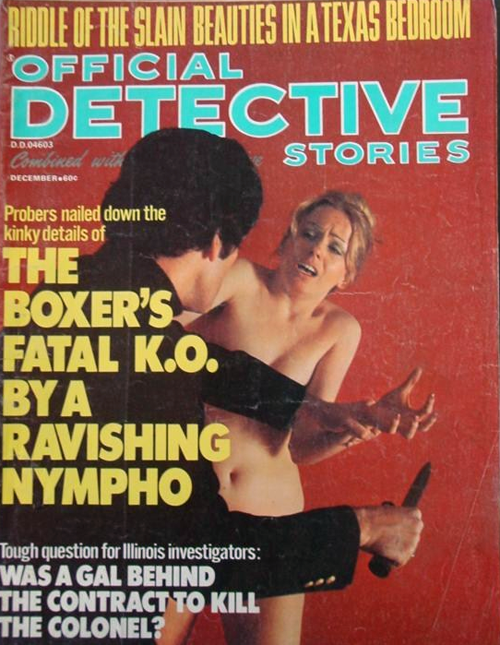
Pulp crime magazines once lived on the newsstand’s edge, and this cover for “Official Detective Stories” leans hard into that lurid tradition. Loud, blocky lettering shouts the sensational headline “The Boxer’s Fatal K.O. By A Ravishing Nympho,” pairing the promise of scandal with the magazine’s claim to “official” investigative grit. Even before reading a single line, the design telegraphs exactly what it’s selling: danger, sex, and violence packaged as true-life mystery.
At center stage, an illustrated confrontation unfolds against a flat, fiery red backdrop—an ominous palette that makes the figures and text pop. A partially clothed woman recoils with an alarmed expression and raised hands, while a man in a dark suit crowds the foreground, gripping a knife. The composition keeps the viewer’s attention trapped between the threat in the man’s hand and the woman’s defensive posture, turning the cover into a miniature thriller meant to provoke an instant reaction.
Beneath the shock value, the artifact is a vivid example of mid-century tabloid storytelling and the marketing of “detective” culture through melodrama. The loaded language, oversized typography, and provocative art reflect how publishers boosted sales with moral panic, sensational crime, and sexualized peril, often blurring the line between reportage and fantasy. For collectors and historians of pulp magazines, this piece offers a sharp look at how crime media was branded—brazen, theatrical, and engineered for quick, irresistible clicks long before the internet.