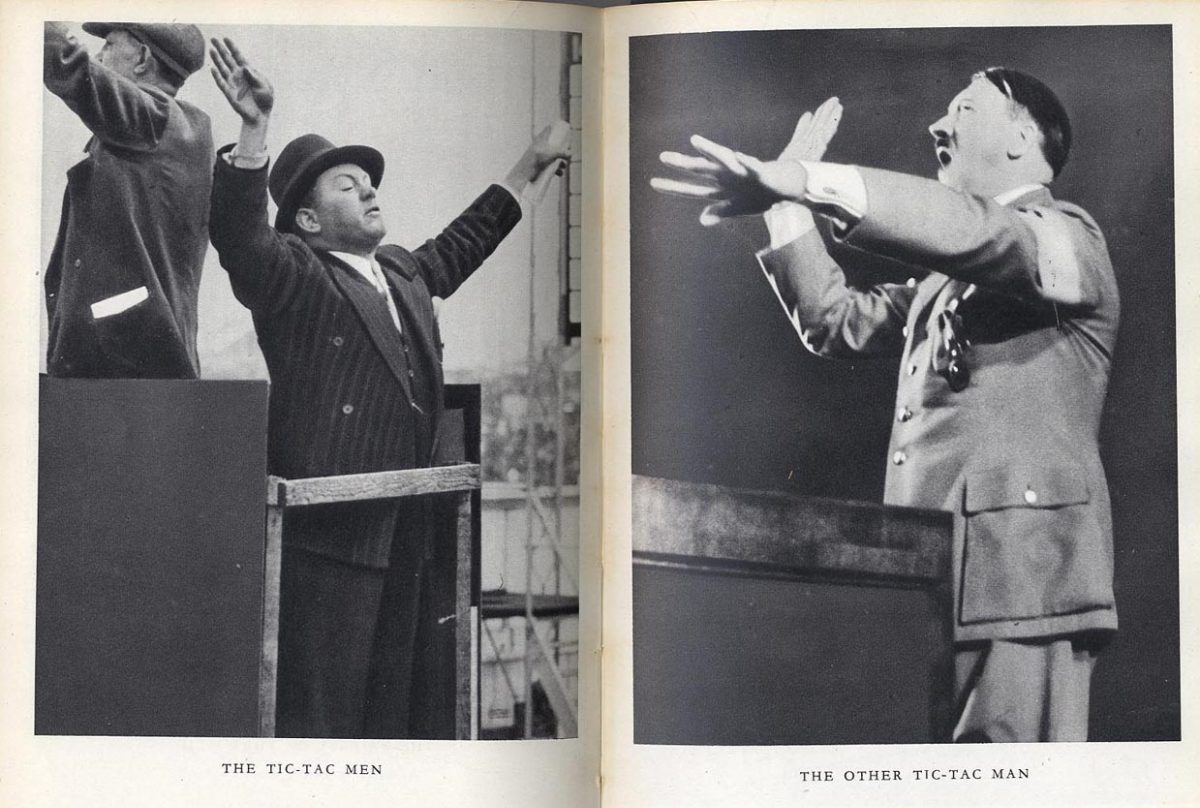
Caught mid-gesture, two suited figures on the left throw their arms into the air like conductors, cheerleaders, or seasoned hecklers working a crowd. The caption “The Tic-tac men” hints at the old stadium art of rapid hand signals—silent, coded, and meant to travel from one spot to another faster than any shout could. There’s a sly humor in the staging: formal clothes, serious faces, and motions so big they become a kind of visual punchline.
Across the page, “The other tic-tac man” presents a single orator at a lectern, mouth open as if projecting to a hall, hands slicing the air in emphatic beats. The similarity of the poses invites comparison, and the joke lands in the echo: the same language of arms can be used to sell odds, rally a crowd, or simply command attention. Even without a stated place or date, the period feel of hats, tailored coats, and stark lighting evokes an era when public performance—politics, sport, and spectacle—leaned heavily on physical rhetoric.
Paired like this, the photograph becomes a miniature essay on communication before microphones did all the work, and it doubles as a playful commentary on how authority is performed. Readers searching for historical photos of crowd signaling, tic-tac men, or vintage gestures will find plenty to linger over in the details: the posture at the rail, the angles of the wrists, the stage-like contrast between the two scenes. Funny, yes—but also a reminder that history often survives in the everyday choreography of hands.