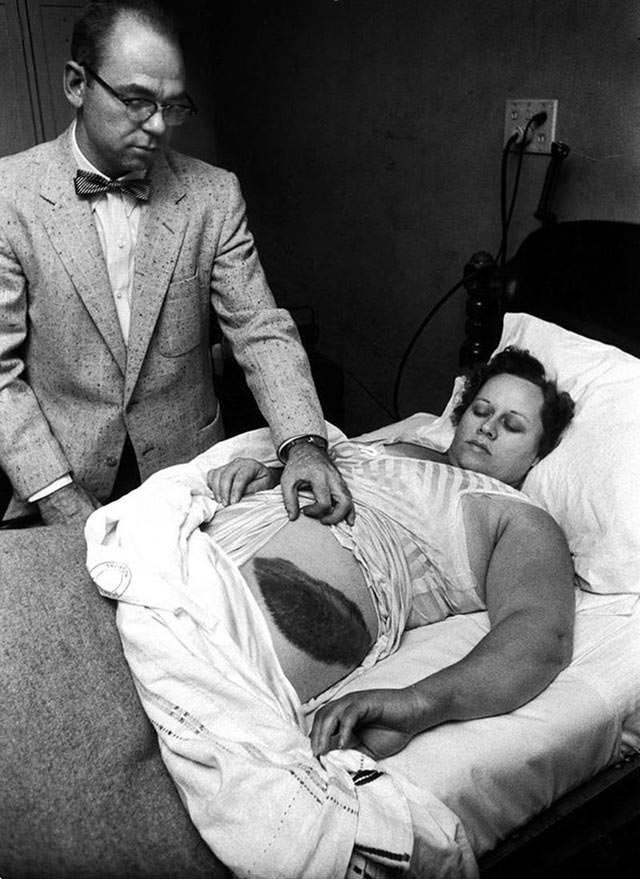
In a quiet hospital room, Doctor Moody Jacobs stands beside his patient, Ann Hodges, drawing attention to a startling mark: a massive bruise spreading across her side. The clinical calm of the setting—white sheets, a simple bed, the doctor’s neat suit and bow tie—collides with the unbelievable story behind the injury. Hodges rests with eyes closed, while the doctor’s hand indicates the impact zone as if documenting evidence for history.
The bruise isn’t just dramatic; it’s legendary, tied to Hodges’ widely reported status as the only person known to have been struck by a meteorite and survived. That contrast between ordinary medical care and an extraordinary event is what makes this 1954 photograph so compelling: it looks like a routine examination until you remember the “patient history” came from outer space. The image reads like a midpoint between science, chance, and human vulnerability.
For readers drawn to unusual moments in American history, space oddities, or mid-century photojournalism, this scene offers a rare intersection of medicine and meteorites. The composition emphasizes proof over spectacle, turning a sensational headline into a tangible, physical record—one bruise, one doctor, one patient, and a story that still feels improbable decades later. It’s the kind of historical photo that keeps resurfacing because it’s both grounded and impossible at once.