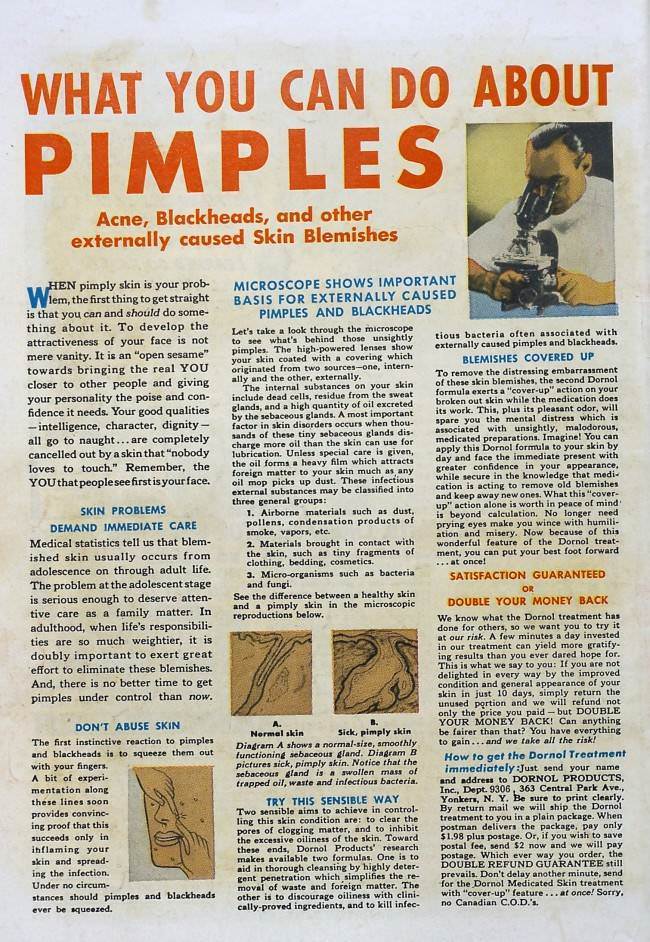
Bold promises leap off the page in the headline “WHAT YOU CAN DO ABOUT PIMPLES,” a classic slice of consumer health advertising that mixes anxiety, reassurance, and salesmanship in equal measure. The copy leans hard into everyday embarrassment—teenage breakouts, blackheads, “externally caused” blemishes—then pivots to authority with a lab-coated figure peering into a microscope. It’s a familiar early-to-mid 20th-century style of marketing, where science imagery is used to make a home treatment feel modern, clinical, and credible.
Alongside the persuasive prose are little educational touches meant to look like medical instruction: diagrams contrasting “normal” and “pimply” skin, warnings about squeezing spots, and talk of bacteria and blocked pores. The brand name “Dornol Products” sits at the center of the pitch, positioned as a remedy that can be mailed directly to you, no doctor required. Even without a clear date or location, the language and layout evoke the era of mail-order cures and magazine-style health advice, when personal hygiene and self-improvement were packaged as a purchase away.
What makes the post title “DOUBLE REFUND GUARANTEE” so fitting is the ad’s confidence in its offer: satisfaction is promised, and the buyer is invited to trust the treatment on the strength of the guarantee. It’s funny now because the rhetoric is so grand—equal parts shame, hope, and “scientific” certainty—yet that over-the-top assurance is precisely what sold products in a crowded marketplace. For readers interested in vintage advertising, acne remedies, and the history of consumer medicine, this piece is a sharp reminder that marketing has long known how to turn an everyday insecurity into a compelling deal.