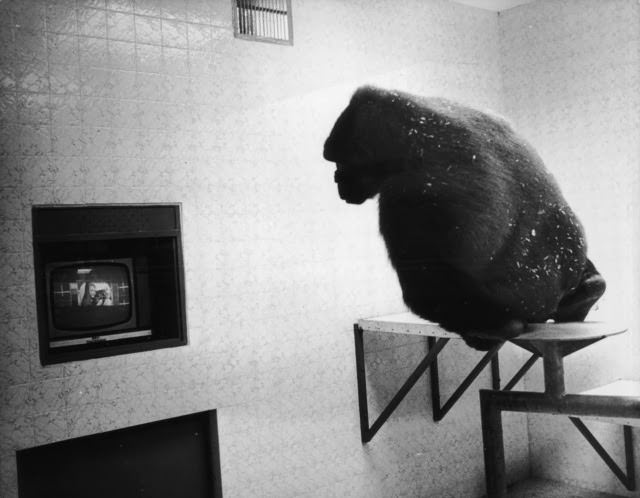
Bongo sits in profile on a raised platform, his broad shoulders and dark silhouette dominating the spare interior of a “luxury enclosure” at Twycross Zoo in Warwickshire. Across the room, a small color television is recessed into the wall, its screen glowing with the unmistakable BBC test-card, a reminder of an era when TV schedules began and ended rather than running endlessly. The scene feels both intimate and slightly surreal: a west African lowland gorilla studying a piece of modern domestic life designed for humans.
What makes the photograph linger is the contrast between soft, living presence and hard, built environment—textured walls, sharp angles, and the boxy set framed like a window. Even without motion or sound, you can almost sense the quiet hum of the television and the pause of curiosity, as if Bongo is weighing the flicker of patterns and faces against the stillness around him. It’s a funny moment, yes, but also a candid snapshot of how zoos in the early 1970s experimented with enrichment and spectacle, reflecting changing ideas about animal care and public expectations.
Seen today, this 1971 image is a small time capsule of Britain’s relationship with technology and wildlife, pairing the novelty of color television with the enduring magnetism of a great ape’s gaze. It invites readers to think about Twycross Zoo’s history, the evolution of gorilla enclosures, and the broader story of how institutions tried to bridge the gap between captivity and stimulation. For anyone searching for vintage zoo photography, BBC test-card nostalgia, or unusual moments in animal history, Bongo’s quiet encounter with the TV set remains oddly memorable.