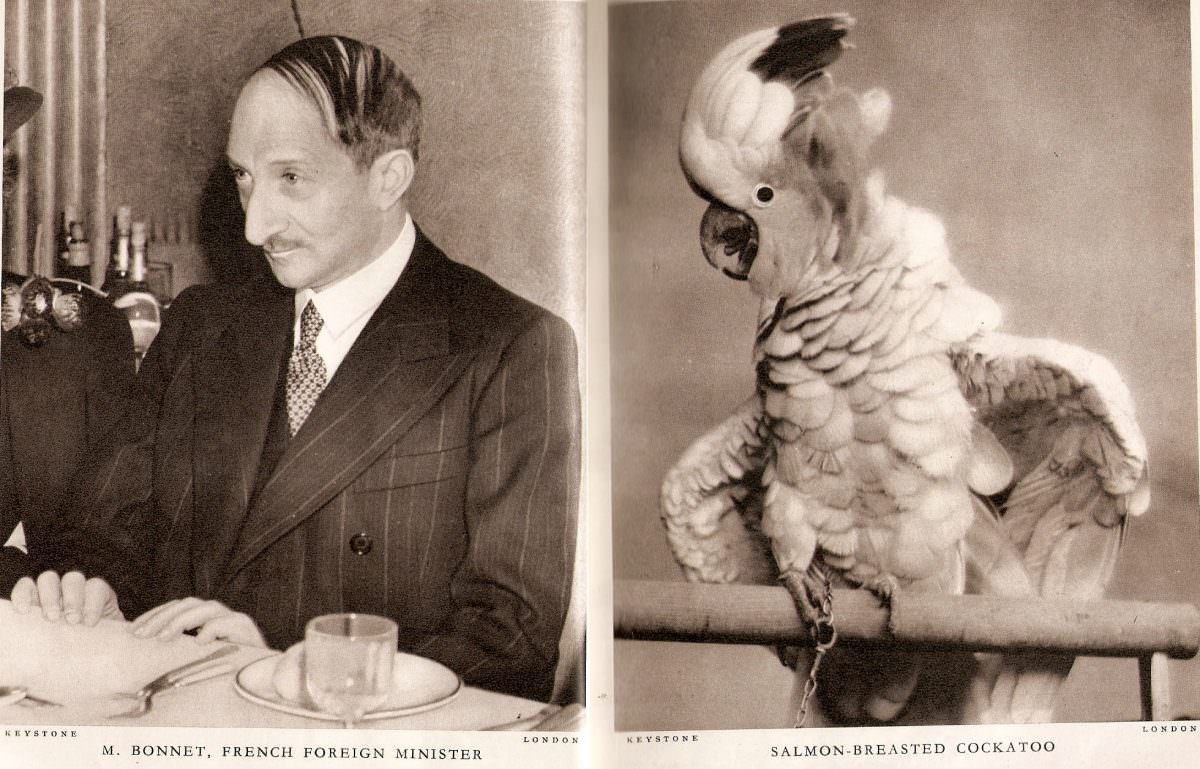
Across a two-page spread, the scene pairs officialdom with oddball charm: on one side sits M. Bonnet, labeled “French Foreign Minister,” composed in a dark suit at a set table with a cup and saucer in the foreground. Bottles and glassware blur behind him, giving the impression of a restaurant or reception setting, while his posture and sideways glance suggest the measured attentiveness of public life. The captioning and presentation feel like a press image meant for wide circulation, where a single candid moment stands in for an entire political persona.
Opposite him, the star is a salmon-breasted cockatoo, photographed in close detail on a perch, crest lifted and beak slightly open as if mid-call. A small chain is visible near its feet, a reminder of how exotic birds were often displayed and handled in earlier eras, especially in metropolitan centers. The bird’s layered plumage and alert pose create a lively counterpoint to the restrained formality of the minister’s portrait.
Putting these images side by side turns the spread into an unintentionally funny bit of visual storytelling—diplomacy and decorum literally sharing the page with flamboyant feathers. For readers searching for M. Bonnet, French foreign minister photos, or vintage cockatoo imagery, it’s a memorable example of how historical photo journalism could mix the serious and the whimsical without explanation. The result is a small time capsule: a glimpse of public figures as they were presented, and of the era’s fascination with striking animals as curiosities worthy of the same spotlight.