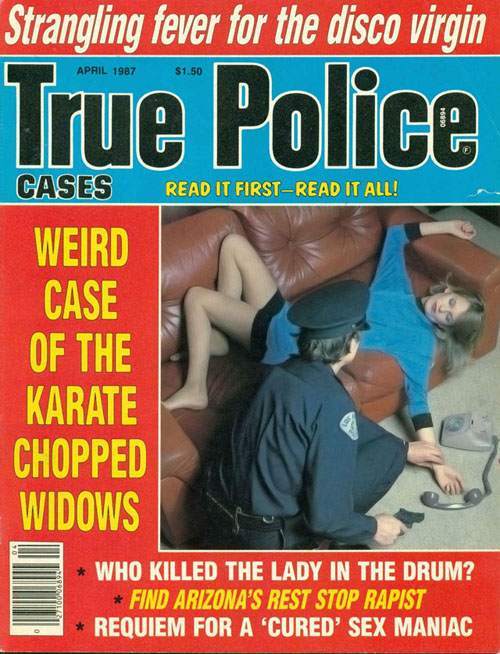
Garish headlines and tabloid bravado jump off this “True Police Cases” magazine cover, sold for $1.50 and dated April 1987, when lurid crime storytelling was its own supermarket genre. The main banner teases “Strangling fever for the disco virgin,” while the bold sidebar promises the “Weird Case of the Karate Chopped Widows,” a hook designed to stop a browsing reader cold. Even before you take in the staged scene, the typography and color blocks telegraph the era’s appetite for sensational true-crime pulp.
At center, a dramatic tableau plays out: a uniformed officer kneels beside a woman sprawled across a couch, her arm extended toward the floor where a handgun lies in reach. The angle feels deliberately cinematic—half police procedural, half exploitation—using everyday furniture and a cramped interior to suggest immediacy and danger. Whether the moment is reconstruction or outright fabrication, the cover trades on the visual language of evidence, proximity, and vulnerability to sell the story.
“Karate chopped widows” reads like a carnival bark, and that’s precisely the point: this kind of 1980s true crime magazine marketed shock, innuendo, and mystery as entertainment. Smaller blurbs—“Who killed the lady in the drum?” and other promises of depravity and redemption—stack up like a menu of outrage, blurring reporting with performance. For collectors, pop-culture historians, and SEO-minded readers searching vintage true crime covers, tabloid magazine history, or 1987 crime pulp ephemera, this artifact is a blunt reminder of how fear and fascination were packaged at the checkout line.