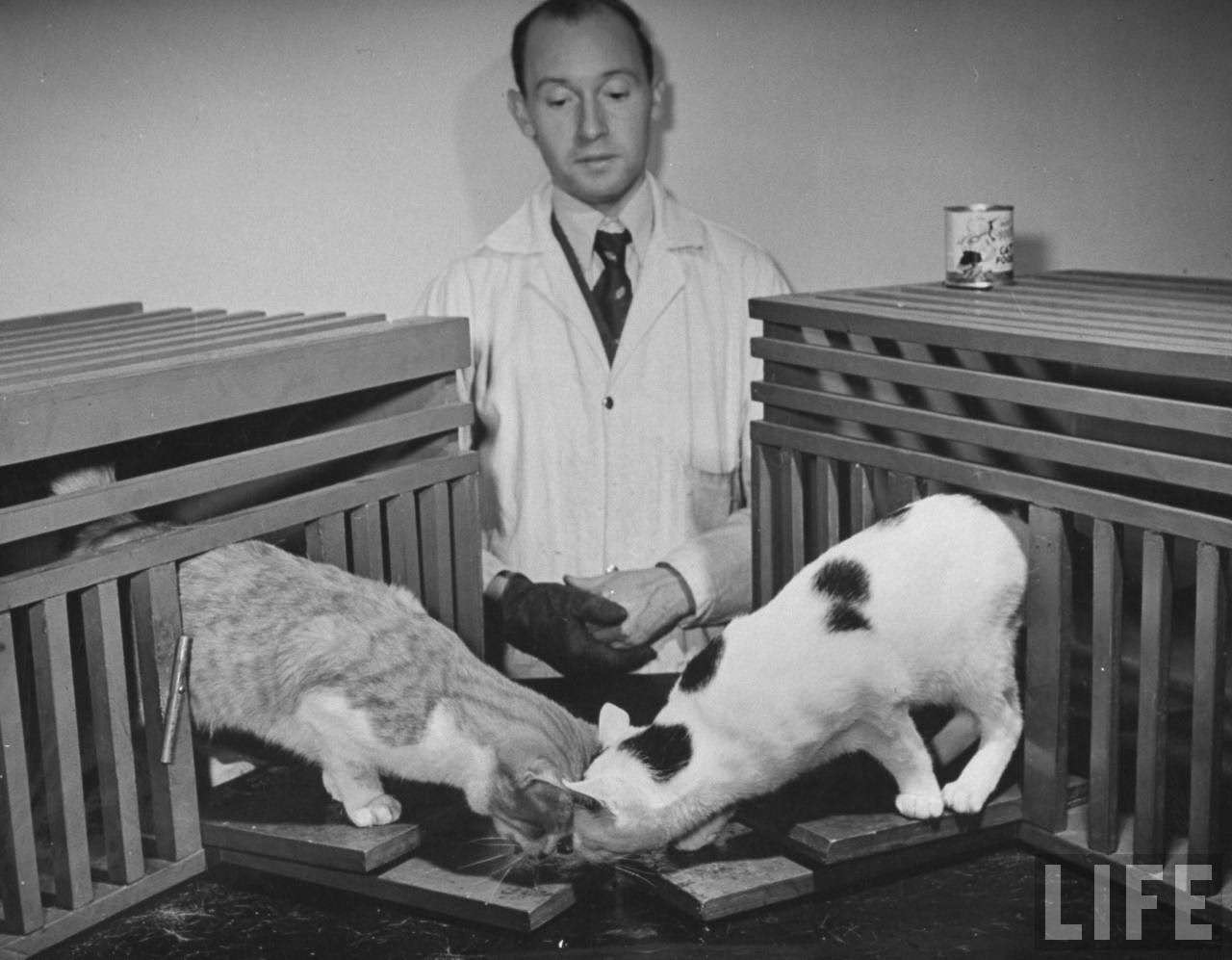
Brooklyn College in 1941 becomes an unlikely stage for a psychology experiment, where two cats are coaxed toward one another across a narrow wooden bridge set between slatted enclosures. A researcher in a white lab coat stands close by, hands poised as if ready to intervene, while the animals negotiate the precarious crossing with whiskers forward and bodies low. The setup feels both earnest and faintly comic—an academic problem rendered in fur, balance, and cautious curiosity.
What makes the scene so compelling is how clearly it reflects mid-20th-century behavioral science in action: controlled space, simple apparatus, and an attempt to turn instinct and decision-making into something observable and measurable. The wooden ramps and boxed pens suggest a focus on choice, hesitation, and confrontation, inviting viewers to imagine what the researchers hoped to learn about learning, motivation, or social responses. Even without the full laboratory notes, the photograph communicates the era’s confidence that careful observation could map the mind—whether human or animal.
For readers drawn to quirky college history, vintage science photography, or the early days of psychology testing, this image offers a memorable glimpse into campus research culture during a pivotal decade. It’s easy to smile at the cats’ mutual standoff, yet the picture also prompts questions about experimental methods, ethics, and how institutions like Brooklyn College participated in wider scientific trends. Viewed today, it’s a striking reminder that the history of psychology is filled with improvised devices, everyday animals, and moments where the serious and the absurd meet on the same narrow plank.