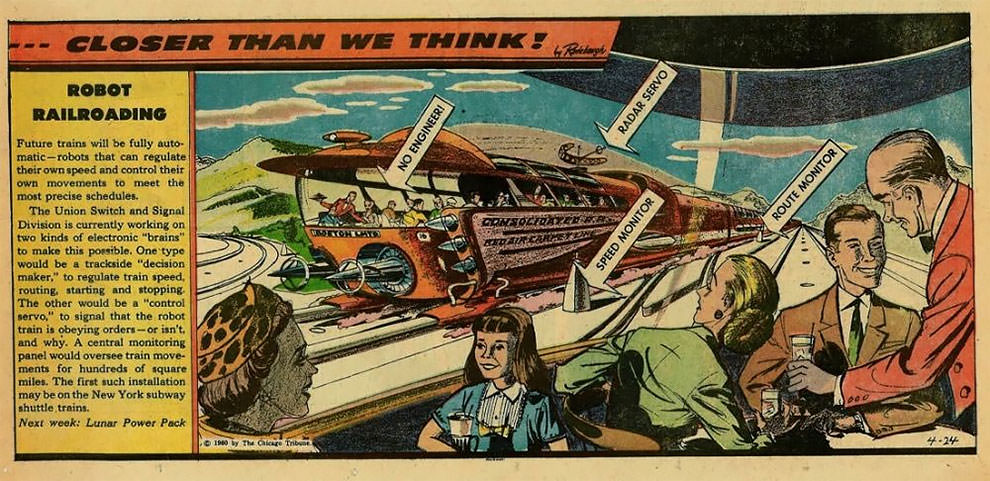
Mid-century optimism runs wild in “Robot Railroading,” a lively newspaper-style illustration that imagines a future where trains drive themselves and passengers relax as if they’re in a lounge. A sleek, streamlined locomotive races along the tracks while callouts like “No engineer!” and “Robot cabo” underline the joke: the humans have been demoted to spectators. Even the family in the foreground looks more interested in refreshments and conversation than in who’s at the controls.
On the left, the accompanying text leans into the era’s fascination with “electronic brains,” describing automatic regulation of speed, routing, starting, and stopping, plus centralized oversight. Labels such as “Speed monitor,” “Route monitor,” and “Radar servo” float above the right-of-way like a futuristic checklist, turning complex railroad operations into a tidy promise of push-button certainty. The headline’s wink—“Closer than we think!”—captures that familiar blend of confidence and salesmanship that colored so much early automation talk.
For WordPress readers who love railroad history, retro futurism, and vintage technology humor, this image is a perfect snapshot of how people once pictured automated trains: fast, safe, and improbably simple. It also doubles as a reminder that behind every “driverless” dream sit layers of sensors, signaling, and monitoring—plus the public’s desire to believe the system is effortless. Share it for a chuckle, or use it to spark a discussion about how yesterday’s predictions compare with modern rail automation today.