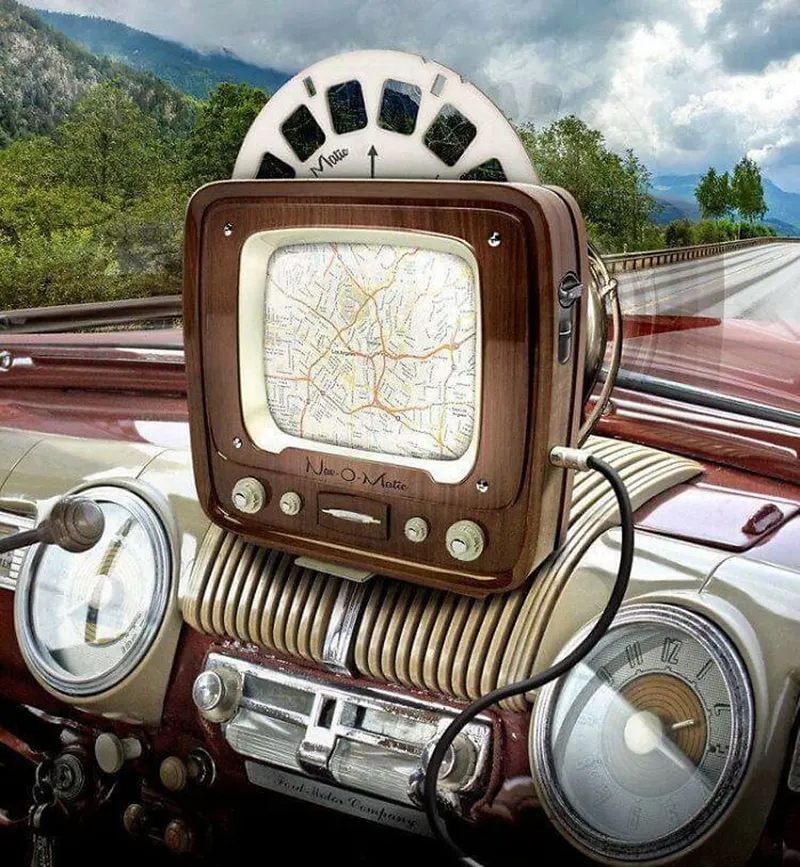
Gleaming chrome and a ribbed dashboard set the scene for a wonderfully impractical idea: a TV-like navigation unit bolted into the middle of a mid-century car interior. The “screen” doesn’t play a program at all—it displays a dense road map, framed like living-room entertainment and topped with a drum-like reel, as if directions could be spooled and tuned in. Outside the windshield, a winding highway and distant hills underline the promise: effortless touring, no paper maps flapping in the breeze.
The humor lands in the details, because everything about the device borrows from 1950s consumer tech—knobs, woodgrain cabinet styling, and a chunky form factor that looks more at home on a console table than in a vehicle. It’s a period fantasy of the future where navigation is mechanical and broadcast-like, with the driver “operating” directions the way one might operate a radio. In an age when highways were expanding and road trips were becoming a cultural ritual, it’s easy to see why designers imagined a dashboard that could do more than point a needle at a speed.
Seen today, this concept reads like an ancestor of GPS, filtered through the era’s faith in gadgets and big, optimistic design. The photo makes a great conversation piece for anyone interested in retro technology, vintage automobiles, or the history of navigation systems—especially the gap between what people wanted and what engineering could actually deliver. Funny, yes, but also strangely prophetic: it captures the moment when the dream of in-car guidance was already on the road, just not yet miniaturized.