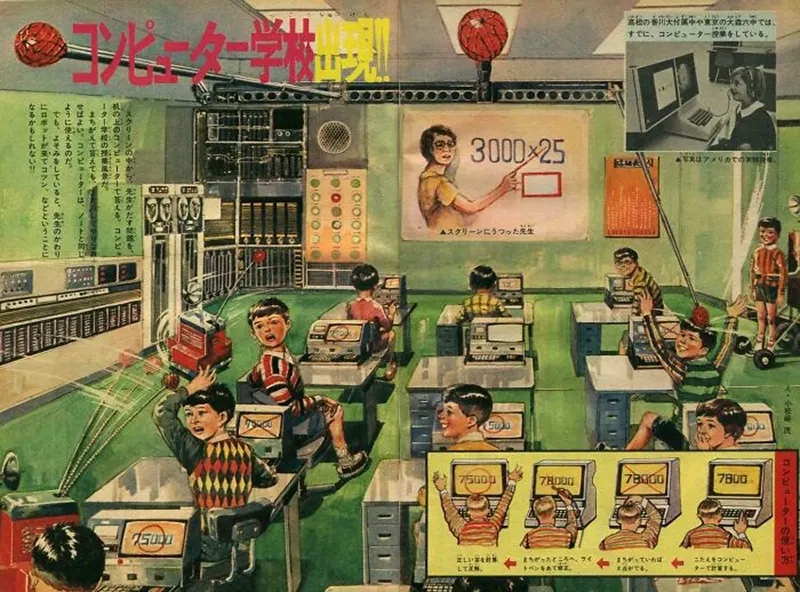
Bright, saturated colors and a busy, gadget-filled classroom sell a very 1960s confidence in technology, where learning looks like operating a control room. Students sit at individual stations with boxy screens, while a teacher gestures at a large board filled with neat figures and symbols, as if computation itself has become the new chalk-and-talk. Even the walls feel engineered—panels, consoles, and speakers hint at a future where education is managed by systems as much as by people.
What makes the scene unforgettable is the discipline-by-machine twist implied in the title: small robots included not to assist, but to correct, literally rapping misbehaving students on the head. It reads as slapstick now, yet it also reveals a period mindset that equated efficiency with obedience, and innovation with tighter control. The illustration’s humor lands because it pushes a real Cold War-era fascination with automation into the realm of classroom authority.
As a snapshot of Japanese “future classroom” imagination in 1969, the image doubles as a cultural time capsule for retrofuturism, edtech history, and how societies picture the next generation being shaped. The chunky computers, individualized terminals, and automated supervision mirror hopes that machines could personalize instruction while smoothing out disorder. Viewed today, it invites an uneasy question: when we dream about smarter classrooms, are we imagining better learning—or simply better enforcement?