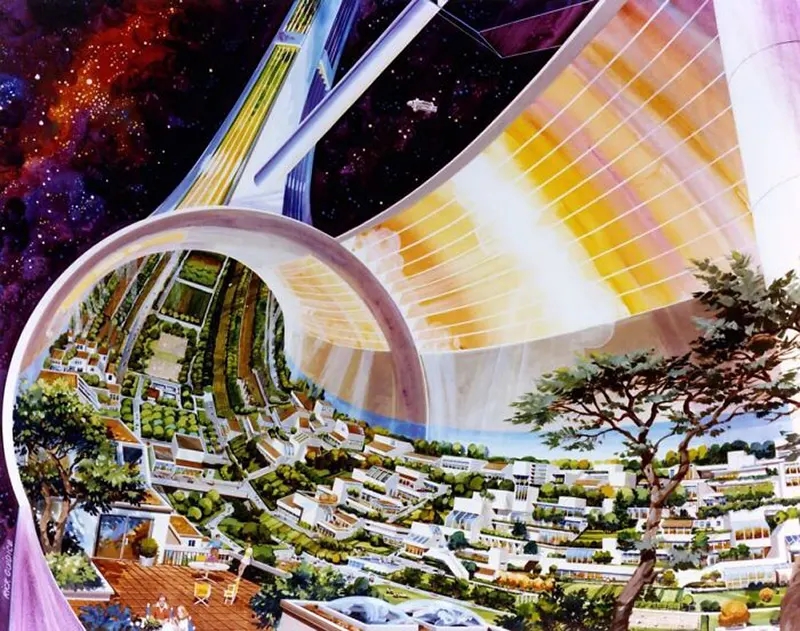
Curving neighborhoods, terraced gardens, and neat clusters of buildings unfurl along the inner wall of a colossal rotating cylinder, a vision of space living that feels part engineering diagram, part utopian travel poster. Sunlight appears to pour through an enormous reflective panel, turning the habitat’s interior into a bright, breathable “sky” despite the starfield beyond. Even the everyday details—roads, trees, and rooftop spaces—suggest planners wanted orbital life to look familiar rather than purely futuristic.
NASA-era concept art like this wasn’t just decoration; it helped translate hard physics into something the public could imagine and debate. Rotation stands in for gravity, while greenery hints at closed-loop life support and the psychological need for nature on long voyages. The design also leans into optimism, implying that a space station could function as a true community with homes, workspaces, and leisure—not merely a cramped laboratory.
In the context of “How NASA imagined life in space..,” the humor comes from how calmly domestic the scene is: it’s suburbia, only wrapped into a wheel and hung against the cosmos. That contrast makes the artwork endlessly shareable for fans of retrofuturism, NASA history, and classic space colony concepts. Look closely and you can feel the era’s confidence that the future would be built, landscaped, and lived in—one carefully planned orbit at a time.