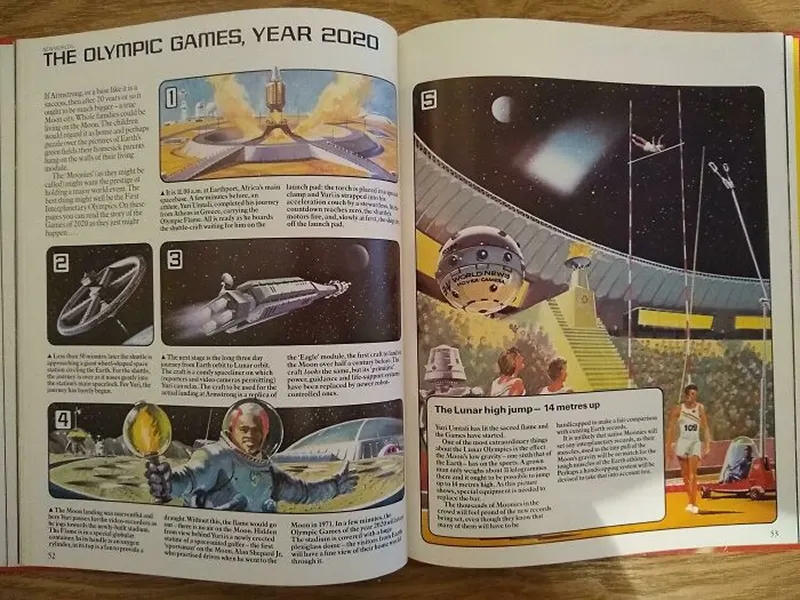
A spread titled “The Olympic Games, Year 2020” opens a charming time capsule from *The Usborne Book of the Future* (1979), where the Olympics are imagined as a space-age spectacle rather than a familiar global broadcast. Rockets, orbiting craft, and gleaming infrastructure dominate the page, presenting the Games as something that would naturally expand beyond Earth once technology caught up with our ambitions. Even before you read the captions, the layout feels like a promise of tomorrow—busy, confident, and a little wide-eyed.
On the right-hand page, the scene shifts to a lunar stadium atmosphere, complete with a banner and a dramatic “Lunar high jump—14 metres up” callout that leans into low-gravity fantasy. The illustrated crowd, the trackside details, and the futuristic architecture aim to make space sport feel plausible, almost routine, as if moon-side athletics would be just another event on the schedule. It’s a wonderful example of retro futurism: not predicting the future so much as revealing what the late 1970s hoped the future would prioritize.
Looking back from the real 2020s, the humor comes from the gap between expectation and reality—no moon arenas, no torch relays by spacecraft, and certainly no mainstream Olympic programme set under a star-filled dome. Yet that mismatch is exactly what makes this historical book illustration so shareable and SEO-friendly for readers searching “1970s future predictions,” “Usborne Book of the Future,” or “Olympics in the future.” The page isn’t “wrong” so much as it’s honest about the era’s optimism, capturing a moment when progress seemed like it would be loud, fast, and pointed skyward.