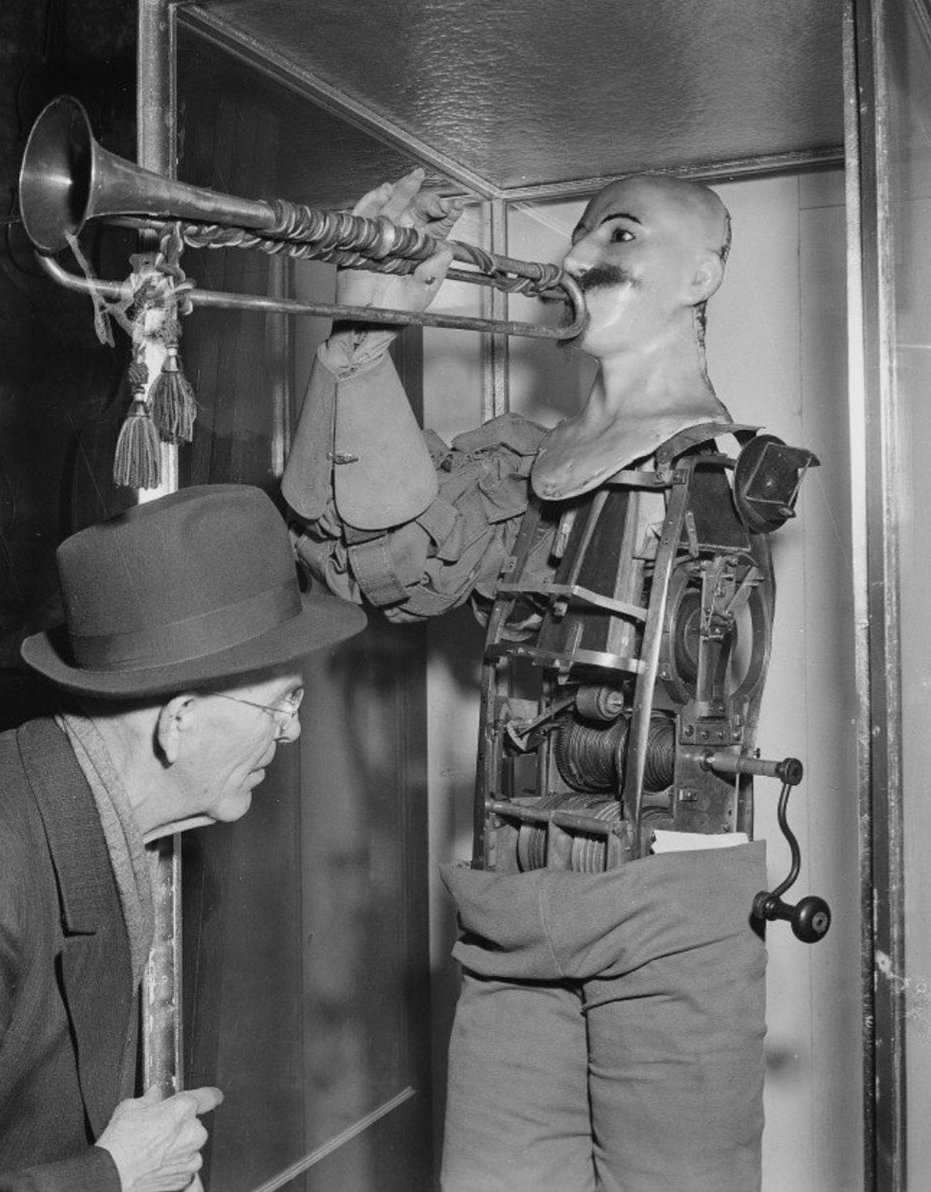
Inside the Deutsches Museum in Munich, a visitor leans in with the careful curiosity of someone meeting the future face-to-face. The exhibit before him is described as the first robot in history, and it looks less like a sleek science-fiction marvel than a painstaking mechanical figure—part mannequin, part machine. Wires, pulleys, and exposed components crowd the torso, while a humanlike head and raised arm give the contraption an unsettling hint of personality.
The details invite a long look: a rigid frame strapped over clothing, a hand set mid-gesture, and a long horn-like tube positioned near the mouth, suggesting an early attempt at sound, signaling, or performance. Instead of hiding the engineering, the display foregrounds it, letting museumgoers study how motion and control were once imagined and built. That openness—showing the guts of the invention—speaks to a mid-century faith that technology could be understood, explained, and improved.
Dated April 30, 1950, the file photo captures a moment when robotics and automation were still more dream than daily reality, yet already compelling enough to draw crowds. For readers interested in inventions, museum history, and the origins of robots, this scene offers a vivid reminder that “firsts” often arrive as strange hybrids: half theatrical, half experimental. In the quiet space of a museum display case, the long arc from mechanical curiosities to modern robots feels suddenly tangible.