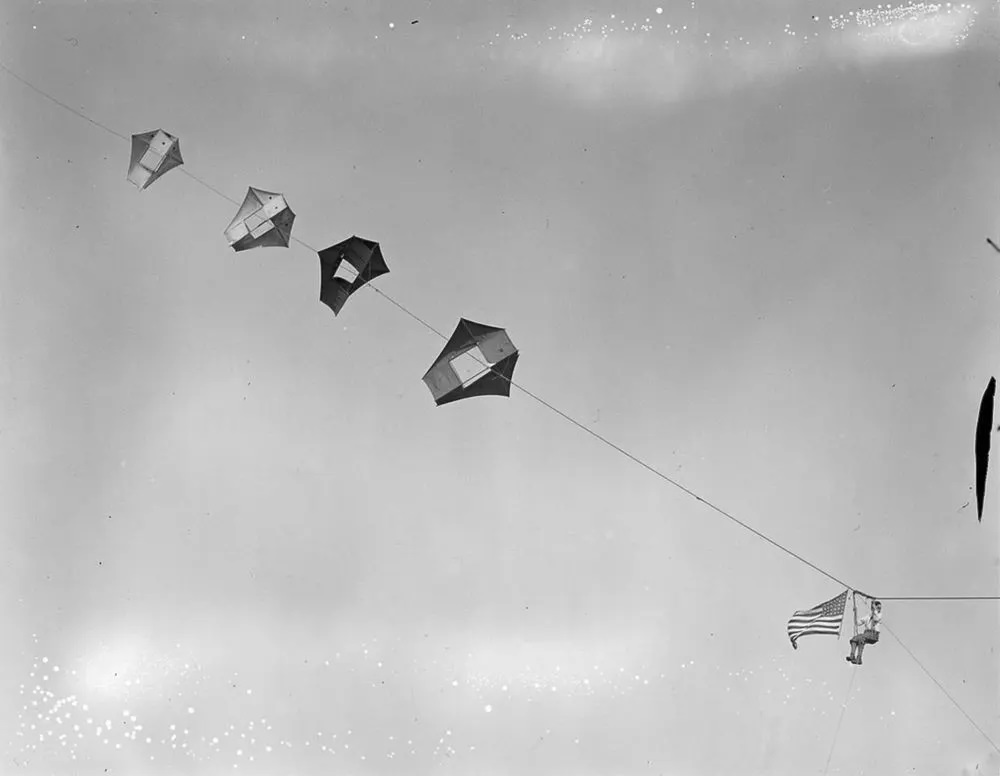
High above an open sky, a train of boxy kites pulls steadily on a long line, each cell catching the wind like a small wing. At the far end hangs a solitary rider, suspended in a harness beneath the tether, with a flag fluttering nearby as if to announce the feat to anyone watching from the ground. The stark simplicity of the scene—just fabric, spars, rope, and air—hints at how much faith early experimenters placed in clever design and favorable weather.
Before aircraft became reliable tools, man-lifting kites offered a surprising route to altitude for observation and signaling, especially in the context of aerial reconnaissance. A series of kites could share the load, building lift in stages and stabilizing the line while raising a person high enough to see beyond obstacles and distance. The technology sits at a fascinating crossroads of invention and necessity, where the familiar childhood toy was transformed into a serious platform for military and scientific ambition.
What makes this moment so compelling is the contrast between the calm expanse of the sky and the precariousness of the human figure dangling beneath it. The photo invites questions about materials, wind conditions, safety lines, and the ground crew required to manage the tension—details that defined whether a launch became a breakthrough or a disaster. In exploring the incredible history of man-lifting kites, this post traces how these windborne systems briefly promised a cheaper, simpler eye in the sky, and why their legacy still echoes in later airborne observation methods.