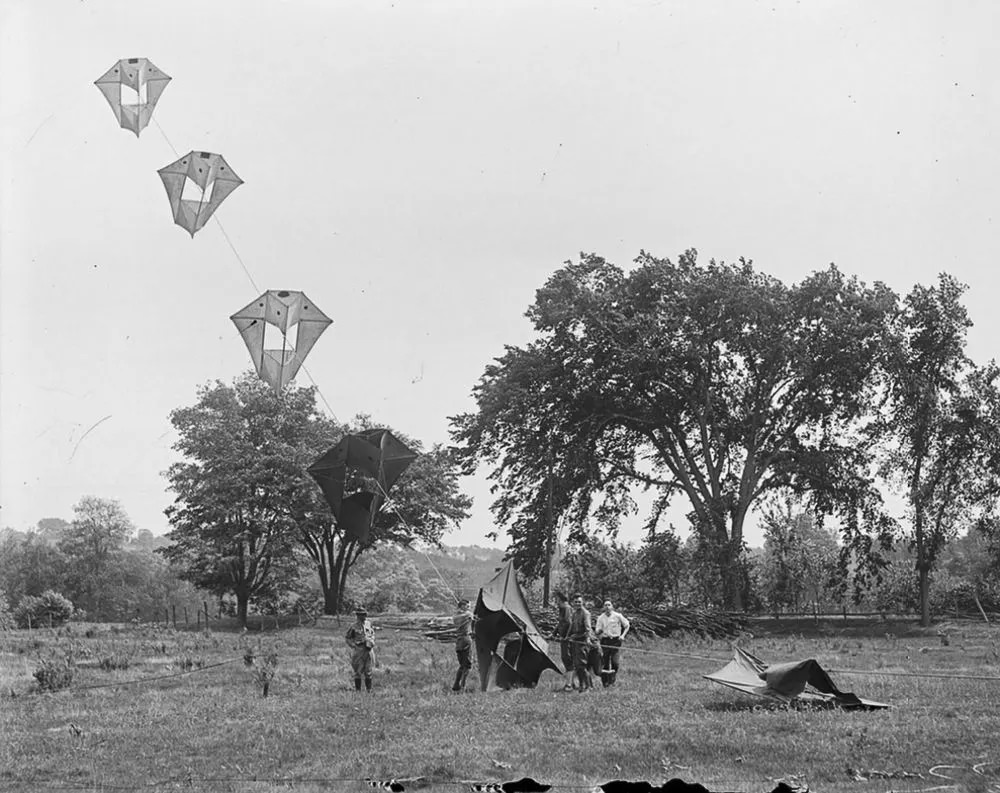
On a quiet stretch of open field, a small team works the lines while a train of man-lifting kites climbs into the pale sky. The repeated, faceted shapes—each one steadying the next—hint at careful engineering rather than play, and the scene feels halfway between a picnic and a proving ground. Against the backdrop of tall trees and low horizons, the kites’ rigid frames and taut cords make the whole operation look both delicate and strangely powerful.
Long before aircraft became routine, aerial reconnaissance technology often depended on wind, patience, and clever design. Man-lifting kites were built to generate enough lift to raise an observer, or at least a payload, giving a view over terrain that ground-based scouts could never match. The photograph’s stacked configuration suggests a practical solution to variable breezes: multiple kites sharing the load, stabilizing one another, and turning a simple idea into a system.
What makes this invention-era experiment so compelling is its mix of daring and method—people on the ground managing a complex rig while the sky does the heavy lifting. The details invite closer looking: the differing kite sizes, the coordinated handling, and the way the equipment sprawls across the grass like an early prototype lab. For readers interested in the incredible history of man-lifting kites, this image offers a vivid reminder that the path to modern surveillance and reconnaissance didn’t begin with engines, but with fabric, spars, and the art of catching the wind.