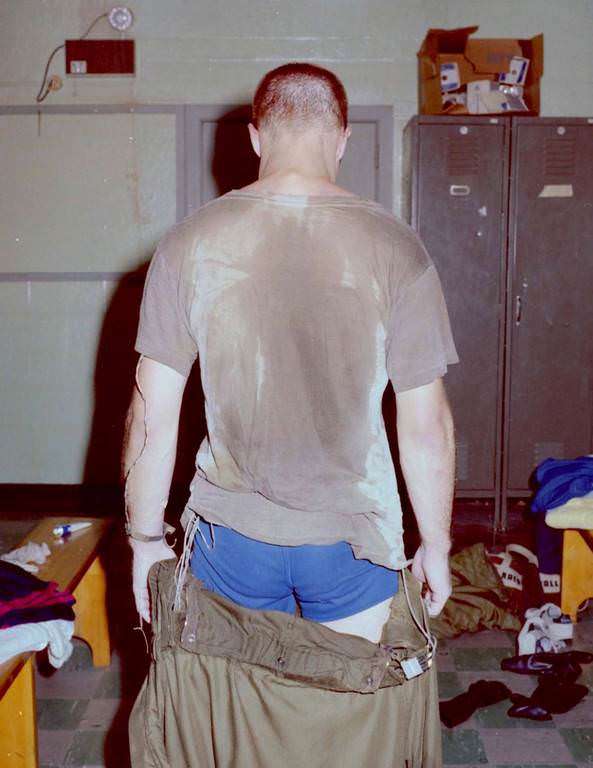
Sweat-darkened fabric clings across the back of a test subject standing in a utilitarian changing room, caught mid-step as he shrugs out of heavy outer trousers. The scene feels unmistakably experimental rather than casual: wires trail along one arm, and the posture suggests someone following instructions while measurements are taken. With its plain walls, lockers, and scattered gear on benches and floor, the room reads like a lab’s practical staging area for evaluating comfort and heat stress.
In the early 1980s, cooling vest testing sat at the crossroads of workplace safety and invention, aimed at people who couldn’t simply “take a break” from heat—whether under protective clothing, in industrial environments, or during demanding training. The damp shirt and instrument leads hint at monitoring body response, a reminder that effective wearable cooling has to balance temperature, mobility, and the realities of sweat, friction, and weight. Even without seeing the vest itself, the photograph documents the unglamorous process behind thermal management technology: trial, data, adjustment, repeat.
“Cooling vest test, 1983” works as a small but vivid artifact of innovation history, grounding modern discussions of wearable tech in the everyday spaces where prototypes were judged by lived experience. Details like the lockers, cardboard boxes, and discarded clothing add authenticity and help readers picture the practical constraints designers faced. For anyone exploring inventions, personal protective equipment, or the evolution of cooling garments, this image offers a candid glimpse at the human body as the ultimate proving ground.