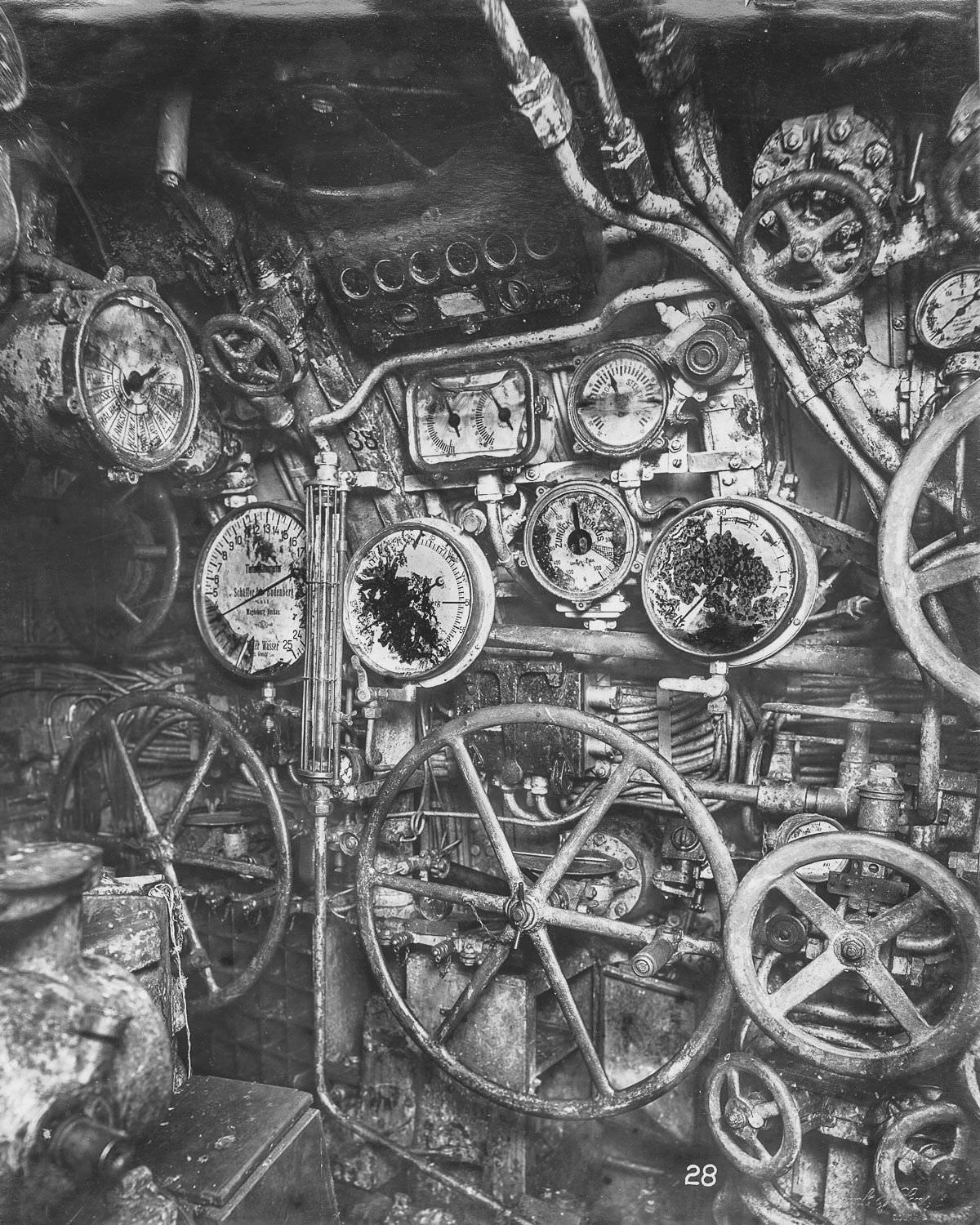
Steel, grime, and tightly packed instrumentation dominate this forward-looking control room view, where the working heart of a submerged vessel is rendered in dials and handwheels. The depth gauge sits among clustered readouts, while engine telegraphs and indicator faces crowd the panel in an almost bewildering array of circular glass and metal. Pipes and linkages thread through the frame, reminding us that early control systems were as much mechanical as they were human—built to be felt, heard, and watched in close quarters.
At the center, the flooding and blowing wheels suggest the constant balancing act required below the surface: taking water in to dive, driving it out to rise, and doing both with discipline. The hydroplane controls hint at fine adjustments—small changes that could steady the boat, alter its angle, and keep it on an intended depth. Even without a visible crew, the layout reads like a choreography of hands, where each gauge and lever demanded attention amid vibration, heat, and noise.
Inventions come into sharp relief here, not as polished showpieces but as hard-used tools that made underwater navigation possible. The photograph is rich for historians and enthusiasts searching for submarine control room details, vintage naval technology, or the evolution of depth control and engine communication systems. Studying the worn surfaces and packed geometry of the panel offers a grounded sense of how innovation looked in practice—crowded, practical, and built for survival.