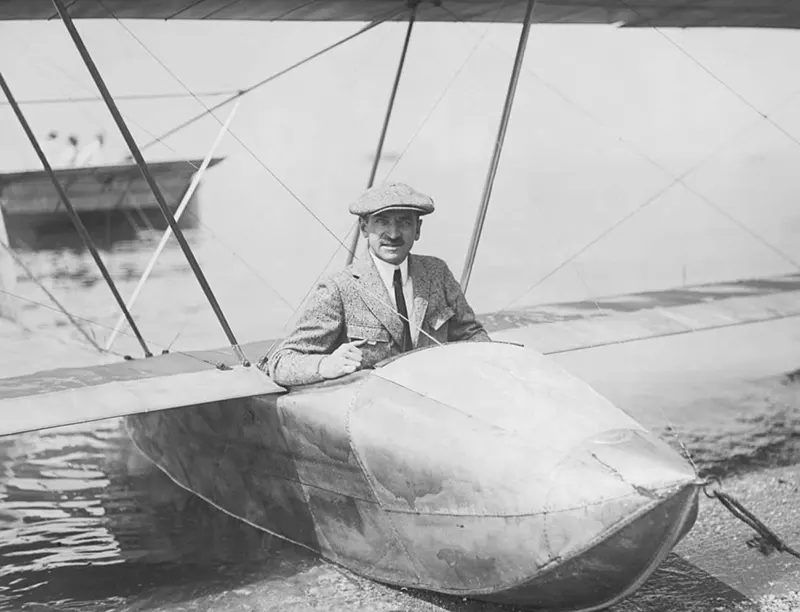
Perched in the cockpit with a flat cap and tie, Glenn Curtiss appears at ease amid a web of struts and bracing wires, seated in an early glider whose slender wings stretch outward like scaffolding. The craft’s fabric surfaces and exposed framework speak to a time when aviation was still being negotiated in wood, wire, and cloth rather than sealed behind sleek panels. Even at rest, the machine looks taut and purposeful, as if it only needs a breath of wind to become airborne.
Behind him, rippling water and the edge of shoreline place this experiment in a practical setting where takeoff and landing could be tested with a measure of forgiveness. The fuselage—or boatlike body—suggests the overlap between gliding and waterborne design, hinting at the era’s restless mixing of ideas and materials. Details like the metal skin near the nose and the careful rigging reveal the hands-on ingenuity that defined early flight, when each component was both structure and lesson.
For readers interested in inventions and the history of aviation, this photograph offers a grounded look at how pioneers presented themselves alongside their machines: confident, curious, and ready to revise tomorrow’s design based on today’s attempt. It’s a vivid reminder that progress often looked improvised up close, built from incremental trials rather than instant breakthroughs. Whether you’re researching Glenn Curtiss, early gliders, or the broader story of experimental aircraft, this image adds texture to the moment when human ambition and fragile engineering began to meet the sky.