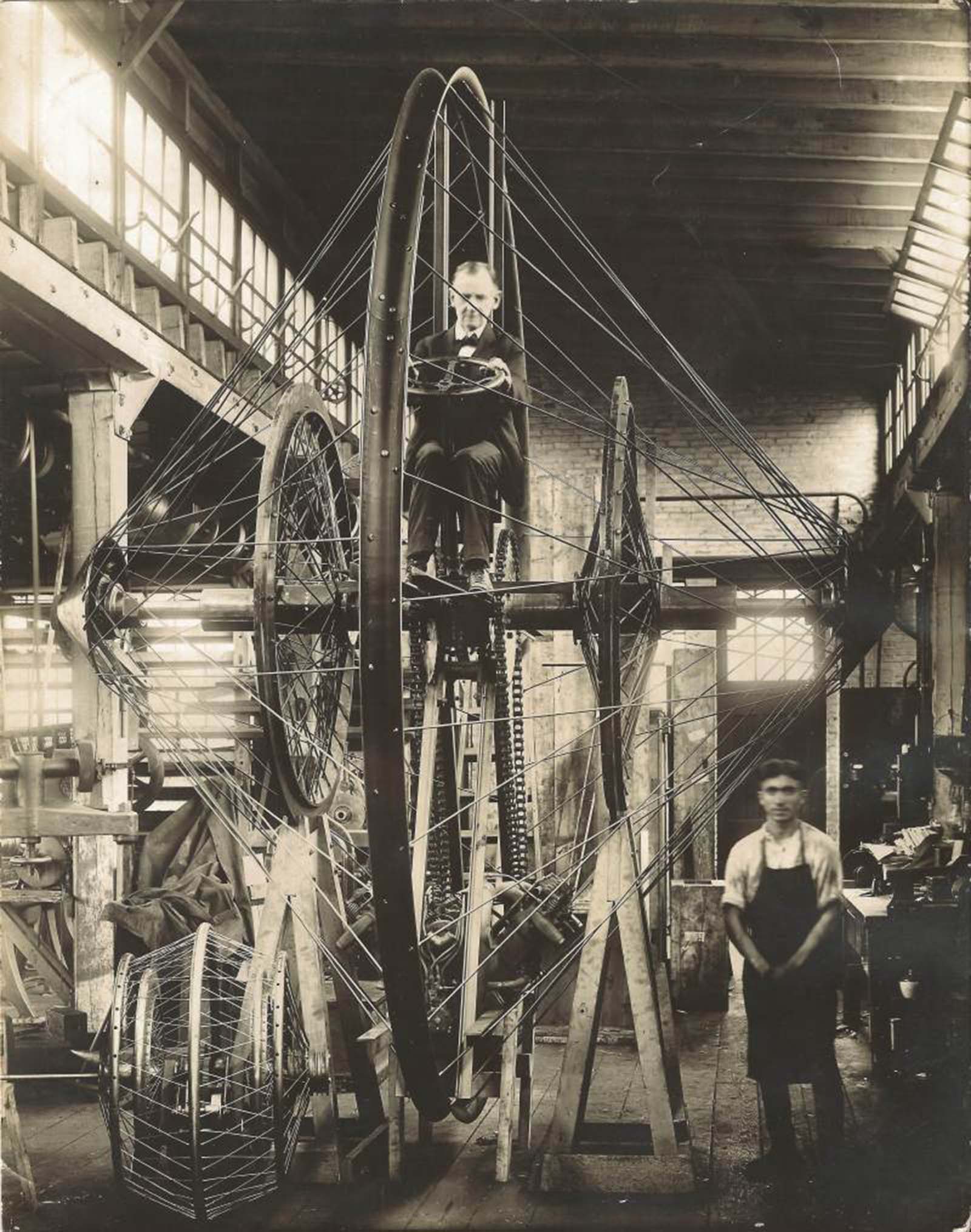
Perched high on a seat framed by a towering single wheel, Professor E.J. Christie poses with the kind of calm confidence that early inventors often cultivated. The monowheel’s sheer scale—described as 14 feet—dominates the workshop around it, its spokes and tensioned lines forming a web of engineering ambition. Even without motion, the machine feels theatrical: part bicycle, part industrial experiment, and entirely meant to make onlookers stop and stare.
Inside the industrial space, the details reward a closer look: timber supports, high windows, and scattered equipment suggest a working factory floor rather than a polished showroom. A chain-driven mechanism and bracing beams beneath the professor hint at how power and balance might have been managed in a design where the rider sits within the wheel’s orbit. At the right edge stands a worker in an apron, grounding the spectacle in everyday labor and reminding us that grand “inventions” are built in ordinary rooms by many hands.
Tales of experimental vehicles often blur the line between prototype and publicity, and the note that this monowheel “may or may not have been tested” only adds to the intrigue. Whether it ever rolled under its own power, the photograph captures a moment in 1923 when bold transportation ideas competed for attention and investment. For readers interested in vintage engineering, unusual vehicles, and the history of invention culture, Christie’s monster monowheel remains a striking emblem of imagination on an industrial scale.