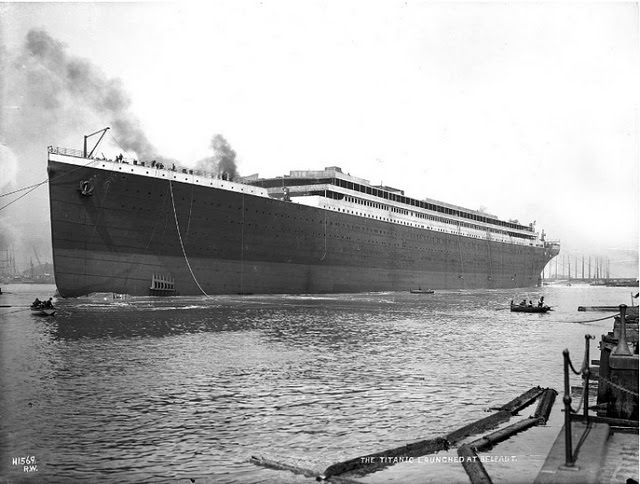
Towering above the harbor water, the Titanic’s immense hull dominates the frame, its dark steel sides rising like a cliff while small boats and dockside details emphasize the ship’s staggering scale. Smoke drifting above the decks hints at machinery waking to life, and the clean, tiered lines of the superstructure suggest a floating city designed for speed, comfort, and prestige. For readers searching the story of Titanic construction, this scene offers a close look at how early 20th-century shipbuilding translated ambition into riveted metal and mile-long silhouettes.
Behind that imposing profile lay a web of inventions and industrial practice—massive slipways, heavy cranes, and teams of workers assembling plates, frames, and decks with relentless precision. The photo’s perspective, looking up toward the bow, underscores the engineering challenge of shaping and supporting such a vast vessel before it ever carried passengers. It’s an effective visual companion to discussions of maritime innovation, from structural compartmentalization and watertight concepts to the logistical coordination required to build an ocean liner at this scale.
Public fascination grew alongside the ship itself, and images like this helped cement the Titanic as a symbol of modern progress long before its maiden voyage entered legend. The calm water and orderly harbor activity contrast with the grand promise implied by the liner’s size, inviting viewers to imagine the era’s confidence in technology and design. As a WordPress feature on “Building the Unsinkable,” this photograph anchors the narrative in tangible details—steel, smoke, and shoreline—while naturally drawing in anyone researching Titanic history, shipyard engineering, and the inventions that defined an age.