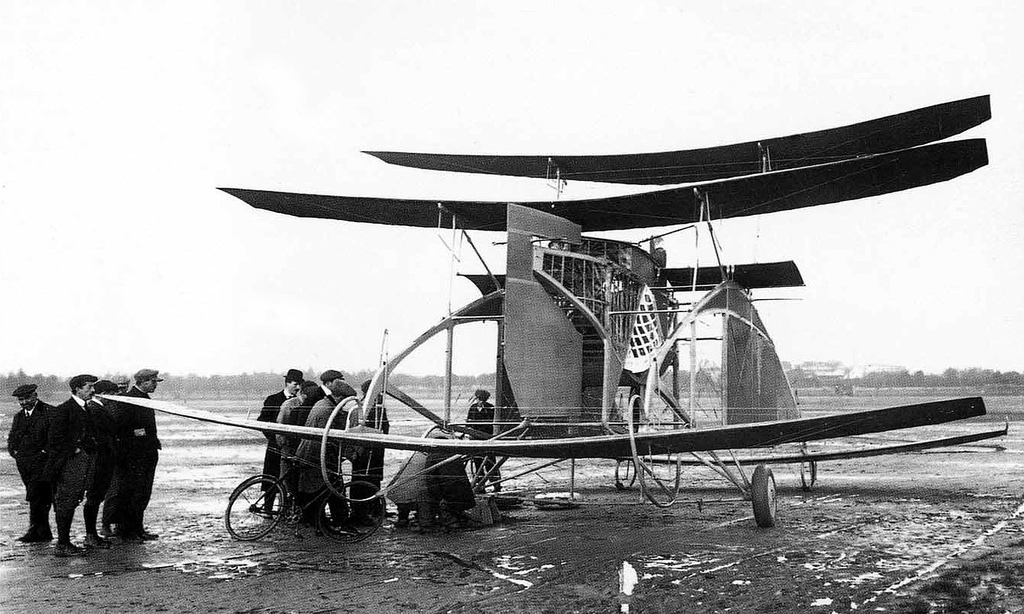
On a muddy field, a cluster of men in heavy coats and hats gathers around a striking experimental flying machine, its long wings stacked in layers above a compact central frame. The title “Vedovelli 1911” places it in the feverish early years of aviation, when inventors and mechanics chased lift with bold geometry and trial-and-error engineering. Every part of the scene suggests a test day—practical clothing, watchful stances, and an aircraft that looks as much like a workshop project as a vehicle meant to leave the ground.
Unusual details pull the eye: spoked wheels, a lightweight structure of struts and ribs, and what appears to be a bicycle-style front assembly that hints at steering or control. The layered wing arrangement and open framework speak to an era before standardized designs, when pioneers experimented with stability, power, and materials using what they could build and repair by hand. Rather than sleek fuselages and enclosed cockpits, the emphasis here is on function—air moving over surfaces, forces traveling through braces, and the constant question of whether theory would survive first contact with wind.
For readers interested in inventions and early flight history, this photograph offers a vivid glimpse of innovation at ground level, where progress depended on observation as much as daring. “Vedovelli 1911” becomes a doorway into the broader story of pre–World War I aeronautics, when airfields were often simple open spaces and each new machine was its own experiment. Look closely and you can almost hear the debate among onlookers: which element will work, which will fail, and what the next revision will be once the day’s tests are over.