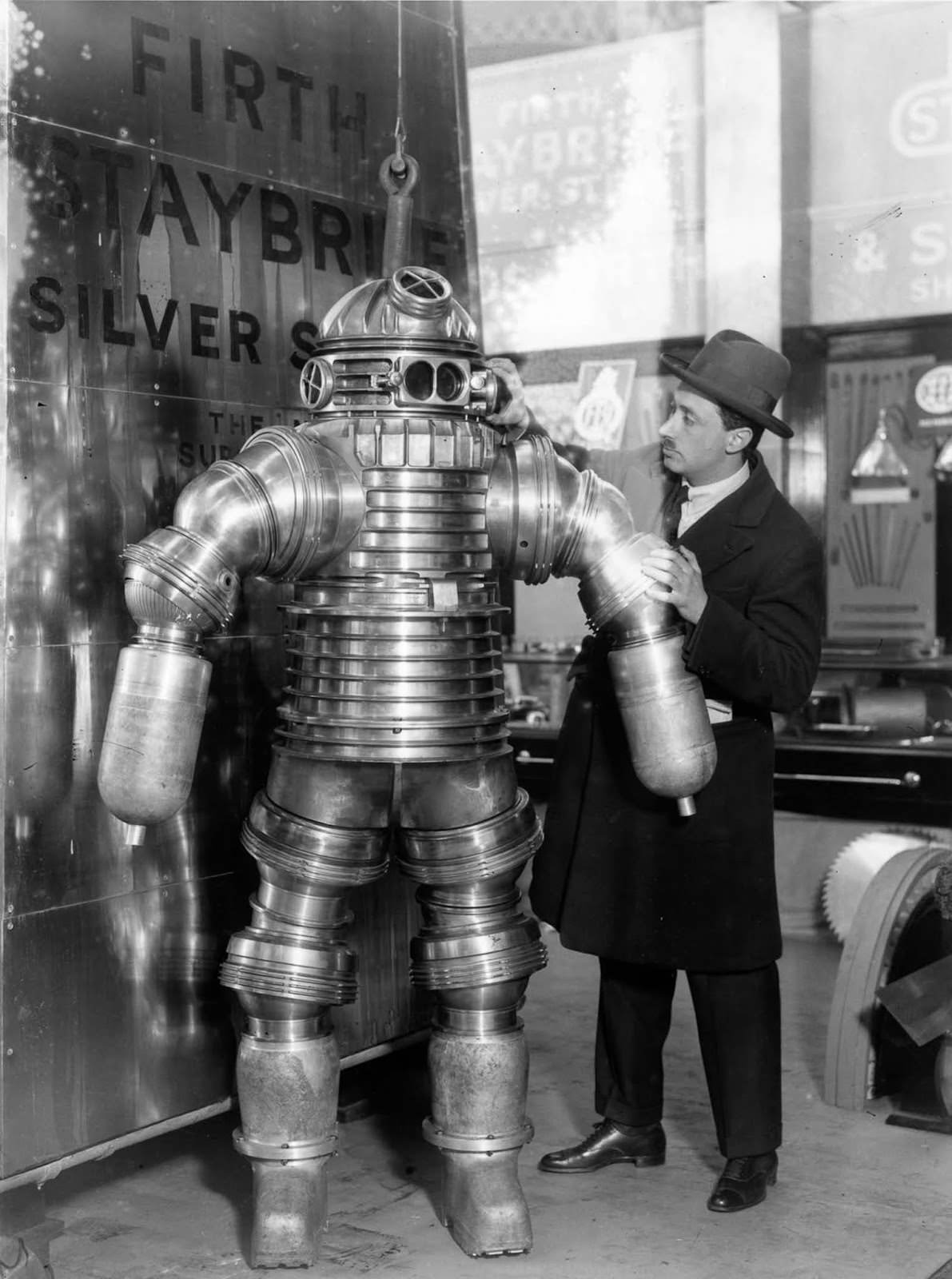
Under the bright hall lighting at London’s Olympia Shipping Exhibition, inventor J. S. Peress stands beside an imposing, almost futuristic diving suit, its polished metal catching every reflection. The figure-like rig is all ribs, joints, and heavy boots, topped with a helmet fitted with round viewing ports and valves that hint at the complexity of breathing and pressure control beneath the surface. Behind him, bold lettering advertises “Staybrite” and “Silver Steel,” underscoring the selling point: a rustless suit designed to resist the sea’s relentless corrosion.
Peress’s hands rest confidently on the suit’s shoulder and helmet as though he’s mid-demonstration for a curious crowd of shipping men and engineers. The segmented torso and thick, articulated arms suggest a careful balance between protection and mobility, while the sturdy connectors at the limbs speak to maintenance, modular parts, and the practical realities of working divers. In an era when salvage, inspection, and underwater construction were becoming ever more important, such a display turned deep-sea labor into something that could be marketed, explained, and modernized.
What makes the scene memorable is the contrast between the ordinary exhibition attire—overcoat and hat—and the extraordinary engineering standing beside it, like a mechanical stand-in for a human body. Trade shows like this were theaters of innovation, where materials like Staybrite Silver Steel promised durability and progress, and where new maritime inventions could win contracts, headlines, and trust. For readers interested in diving history, industrial design, and early 20th-century technology, this photograph offers a vivid glimpse of how “rustless” was more than a boast—it was a breakthrough to be sold on the showroom floor.