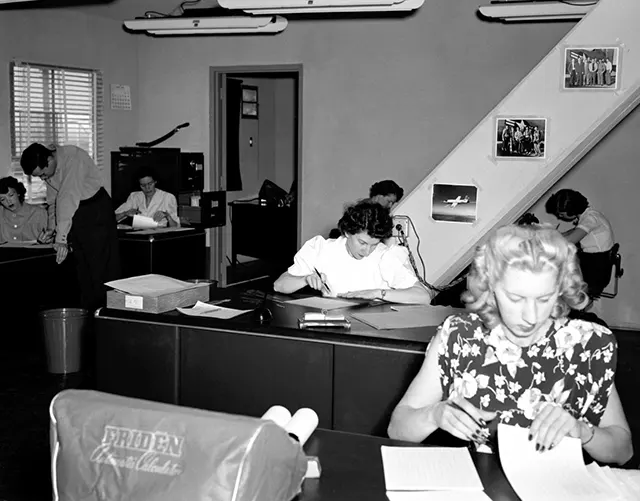
Inside the NACA High Speed Flight Station “Computer Room” in 1949, the work of flight research looks more like a bustling office than a cockpit. Women and men concentrate at desks crowded with papers, notebooks, and calculating tools, while a prominent mechanical calculating machine sits in the foreground, hinting at the era’s reliance on electromechanical horsepower. The room itself—windows with blinds, utilitarian furniture, and a steady rhythm of clerical motion—suggests an environment built for precision and repetition.
Along the wall and up the diagonal underside of a staircase, small pinned photographs add a quiet visual thread connecting the desk-bound calculations to the aircraft they served. Those images, including an airplane in flight, act like reminders: every column of numbers and every handwritten correction ultimately fed into the high-speed aeronautics being pursued at the station. It’s a snapshot of research culture where teamwork mattered, and where “computers” were people performing painstaking computation long before digital screens became the face of science.
For readers searching for NACA history, early aerospace computing, or the behind-the-scenes labor that powered mid-century aviation advances, this scene captures a pivotal transition in technology and workflow. The term “computer room” here speaks to a human system—trained staff, standardized procedures, and mechanical aids—turning raw test data into usable engineering knowledge. Inventions don’t arrive fully formed; they’re assembled, checked, and rechecked in rooms like this.