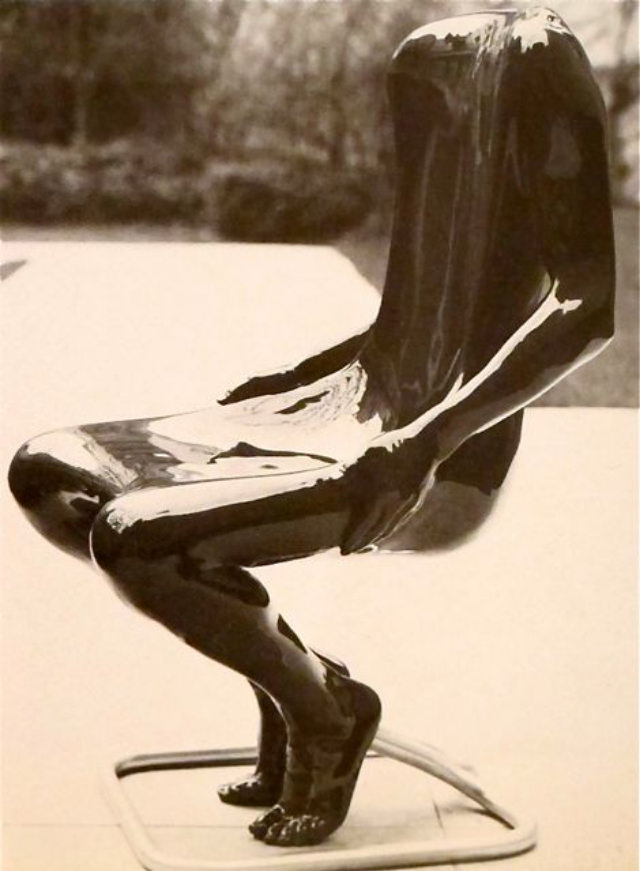
A glossy, human-shaped seat dominates the frame, its polished surface catching light like wet lacquer and turning the familiar outline of a body into something uncanny and elegant. The figure is frozen in a poised sit, with legs angled forward and feet planted, while a minimal metal base curves beneath like a quiet underline. Set against a soft, out-of-focus outdoor backdrop, the chair reads less like ordinary furniture and more like a sculptural object staged for contemplation.
Ruth Francken’s Homme Chair has long been discussed as a witty collision of fashion, design, and pop-era experimentation, and the photograph leans into that provocation. The absent head and simplified anatomy invite the viewer to focus on silhouette, posture, and surface—how desire and design can be engineered through form alone. In the context of “inventions,” it feels like a manifesto: take the most personal of human contours and translate it into an industrial, reproducible object that still retains the charge of a living presence.
Look closely and the tension becomes the story—comfort versus spectacle, utility versus art, the everyday act of sitting versus the unsettling intimacy of sitting on a body. The reflective finish amplifies that ambiguity, mirroring highlights and shadows until it’s hard to tell where sculpture ends and furniture begins. For readers drawn to mid-century design history, provocative modernist furniture, and the origins of functional art, this image offers a memorable entry point into Francken’s boundary-pushing imagination.