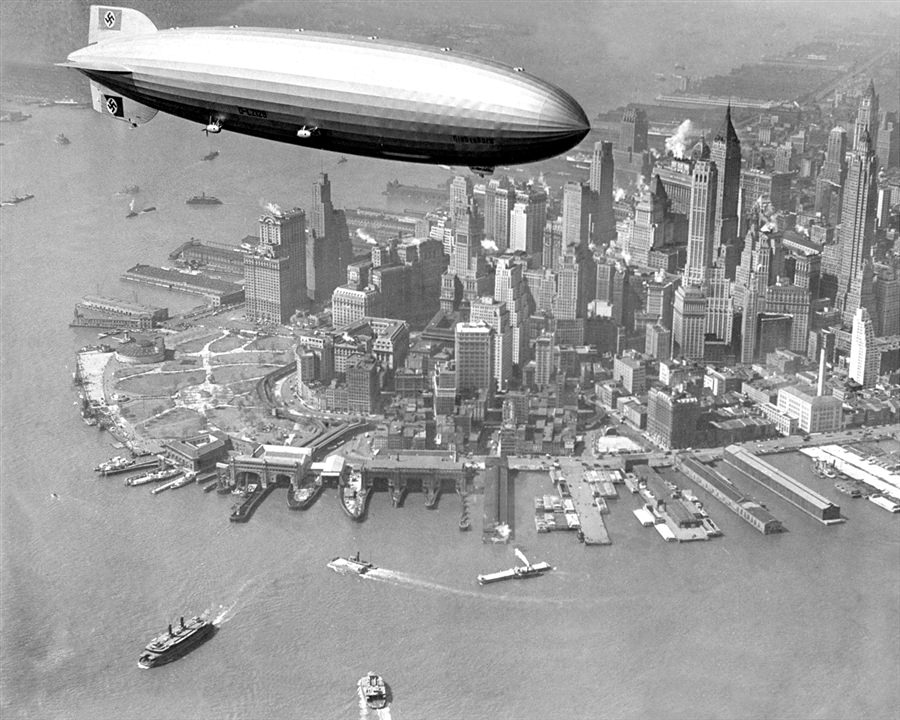
Towering above the dense skyline of Manhattan, the Zeppelin Hindenburg glides like a polished silver ship, its vast hull dwarfing the jagged line of Art Deco skyscrapers below. The aerial perspective emphasizes the city’s waterfront—piers, slips, and ferry traffic stitched along the edge of the island—while the airship’s shadowless presence feels almost unreal against the gridded streets. Details on the tail fin and markings hint at the political atmosphere of the era, a reminder that aviation spectacle and world events were often intertwined.
On April 1, 1936, this kind of flight embodied the optimism—and the showmanship—of interwar engineering, when rigid airships promised a glamorous future for long-distance travel. From this height, Manhattan reads as both modern and compact, a metropolis still leaning on its harbor as much as its towers, with steam and haze softening the outlines of buildings. The Hindenburg’s streamlined design, paired with the city’s vertical ambition, creates a striking meeting of technologies: lighter-than-air flight floating over the capital of American high-rise construction.
For readers drawn to inventions and early aviation history, the photo offers more than a dramatic moment; it captures a brief window when the “airship over New York” was a believable vision of tomorrow. The contrast between the quiet, buoyant glide above and the busy maritime world below underscores how transportation networks overlapped in the 1930s. As a historical image of the Hindenburg over Manhattan, it invites us to imagine the soundscape, the public attention, and the sense that the sky itself was becoming part of the city.