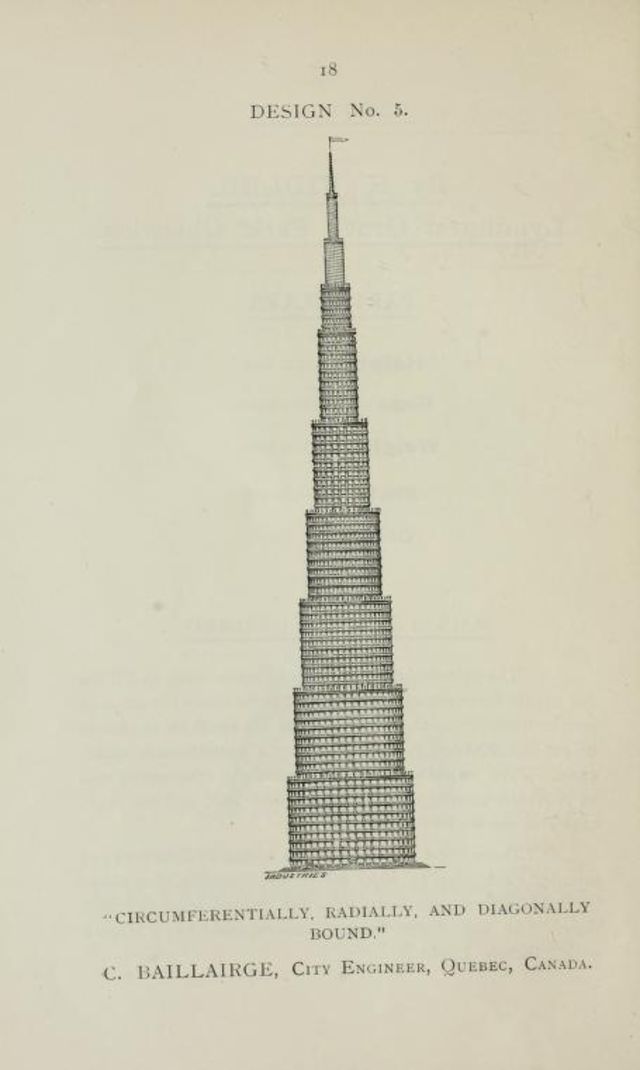
Perched on a sparse page marked “Design No. 5,” this slender proposal rises in stacked tiers toward a needle-like spire, a vision of vertical ambition meant for the 1890 competition to build a “Great Tower for London.” The draughtsmanship is crisp and methodical, presenting a stepped massing that reads almost like a giant telescoping column. With little background detail to distract the eye, the viewer is pushed to study proportion, rhythm, and the sheer audacity of height.
Beneath the drawing, the captioned phrase “Circumferentially, Radially, and Diagonally Bound” hints at the engineering logic behind the silhouette—an age when designers sold ideas as much through structural theory as through ornament. The credited author is listed as C. Baillairgé, City Engineer, Quebec, Canada, a reminder that London’s late‑Victorian tower dream drew submissions well beyond Britain. Even without elaborate flourishes, the proposal suggests a modernist instinct: repetition, modularity, and an emphasis on stability made visible in the building’s disciplined geometry.
Competition drawings like this act as time capsules of invention, revealing how architects and engineers imagined landmark towers before any single scheme could define the skyline. For readers exploring the history of London architecture, Victorian engineering, and ambitious unbuilt projects, this page offers a focused glimpse into the era’s “bigger, higher, bolder” mindset. It also underscores what these contests really produced: not just a winning design, but a gallery of competing futures rendered in ink and confidence.