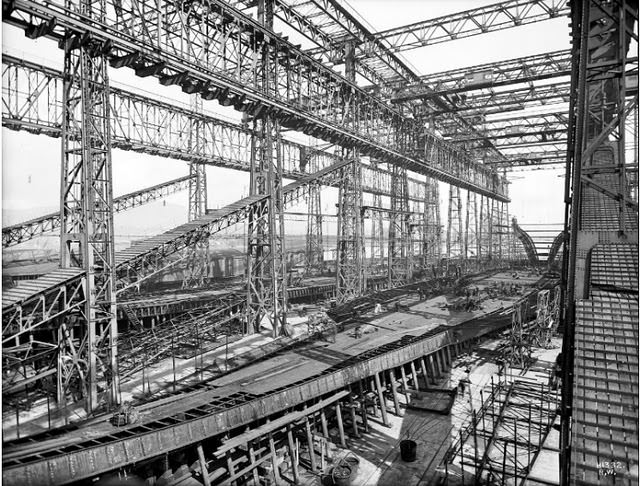
Steel gantries and latticed cranes crowd the skyline above a vast slipway, where the skeleton of a great ocean liner begins to take shape. The scene is all angles and riveted muscle: towering frameworks, suspended walkways, and stacks of material arranged for relentless assembly. Even without a single finished deck in view, the scale suggests a shipbuilding project meant to dominate headlines and redefine what a passenger ship could be.
Along the length of the yard, the organized chaos of industry tells its own story—temporary scaffolds, work platforms, and heavy lifting gear positioned to feed a growing hull. This is the world behind the “unsinkable” reputation, where bold claims were forged not in brochures but in workshops, drafting rooms, and careful routines repeated thousands of times. The construction era of the Titanic invites a closer look at the inventions and engineering choices that made such ambitions seem achievable.
From a WordPress reader’s perspective, the photograph offers more than atmosphere; it’s a searchable window into early 20th-century maritime technology, industrial shipbuilding, and the rise of modern ocean travel. The intricate web of structure overhead hints at the coordinated logistics required to assemble massive sections, install systems, and accelerate production on a tight schedule. Paired with the post’s theme, it underscores how innovation, confidence, and spectacle combined to propel Titanic from a worksite project to a global symbol of progress.