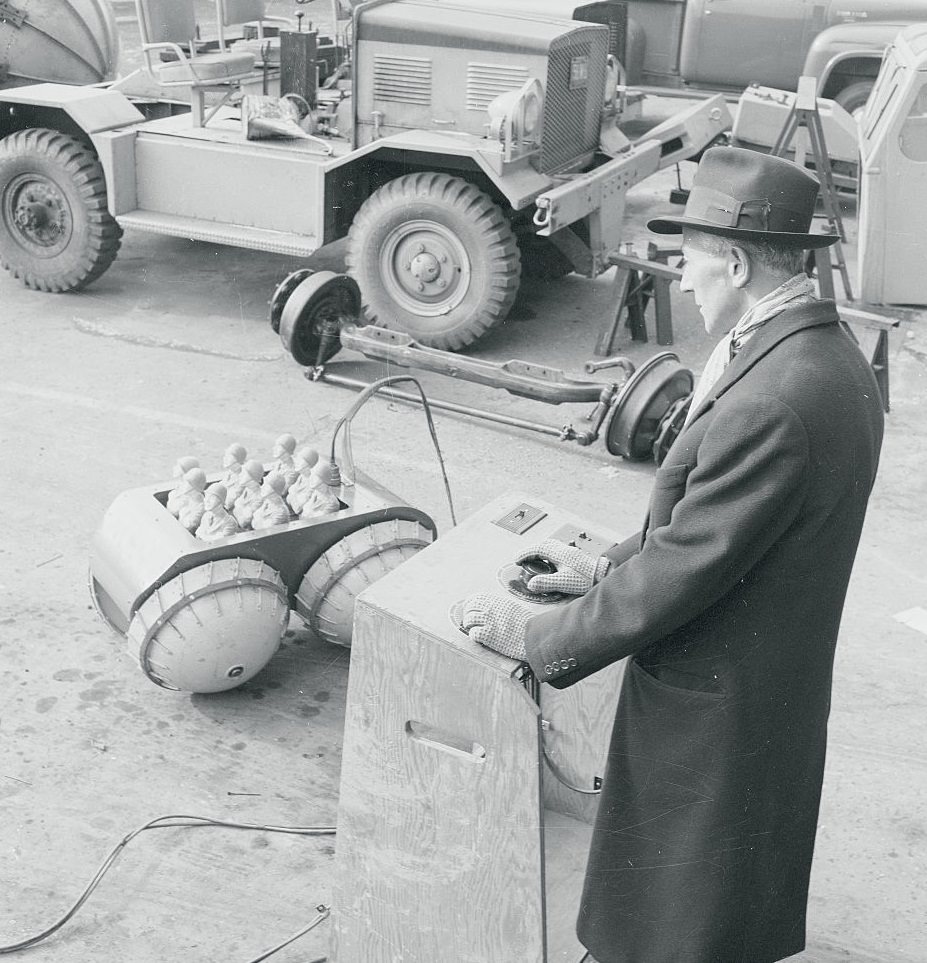
Elie P. Aghnides stands at a control console on the Marmon-Herrington Co. Inc. shop floor, dressed for the occasion in a long coat, hat, and work gloves while he demonstrates his invention, the “Baby Rihno.” Thick cables trail across the concrete to a compact, low-slung machine whose unusual, rounded rollers and squat chassis hint at a vehicle designed to do something ordinary wheels struggle with. The setting—industrial equipment in the background, parts and frames nearby—places this moment squarely in the world of practical engineering rather than the showroom.
What draws the eye is the Baby Rihno itself: twin drum-like rollers at the front and a shallow platform behind them, topped with a cluster of small, cone-shaped objects that look like test loads or markers for the demonstration. The machine’s profile suggests an experiment in traction and stability, the sort of workshop trial where inventors prove an idea not with words but with motion, weight, and contact against the ground. Aghnides’ hands rest on the controls as if he’s ready to pivot, crawl, or climb—showing how a novel drivetrain or wheel concept might handle rough surfaces.
Scenes like this are a reminder that innovation often arrives in humble prototypes, tested amid grease, tools, and heavy vehicles rather than under bright lights. For readers interested in invention history, early vehicle engineering, and Marmon-Herrington’s industrial context, the photo offers a vivid snapshot of hands-on experimentation—one inventor, one machine, and an audience implied just outside the frame. It’s the kind of archival image that invites questions about how the Baby Rihno worked, what problems it aimed to solve, and how such demonstrations shaped the next steps from workshop concept to real-world application.