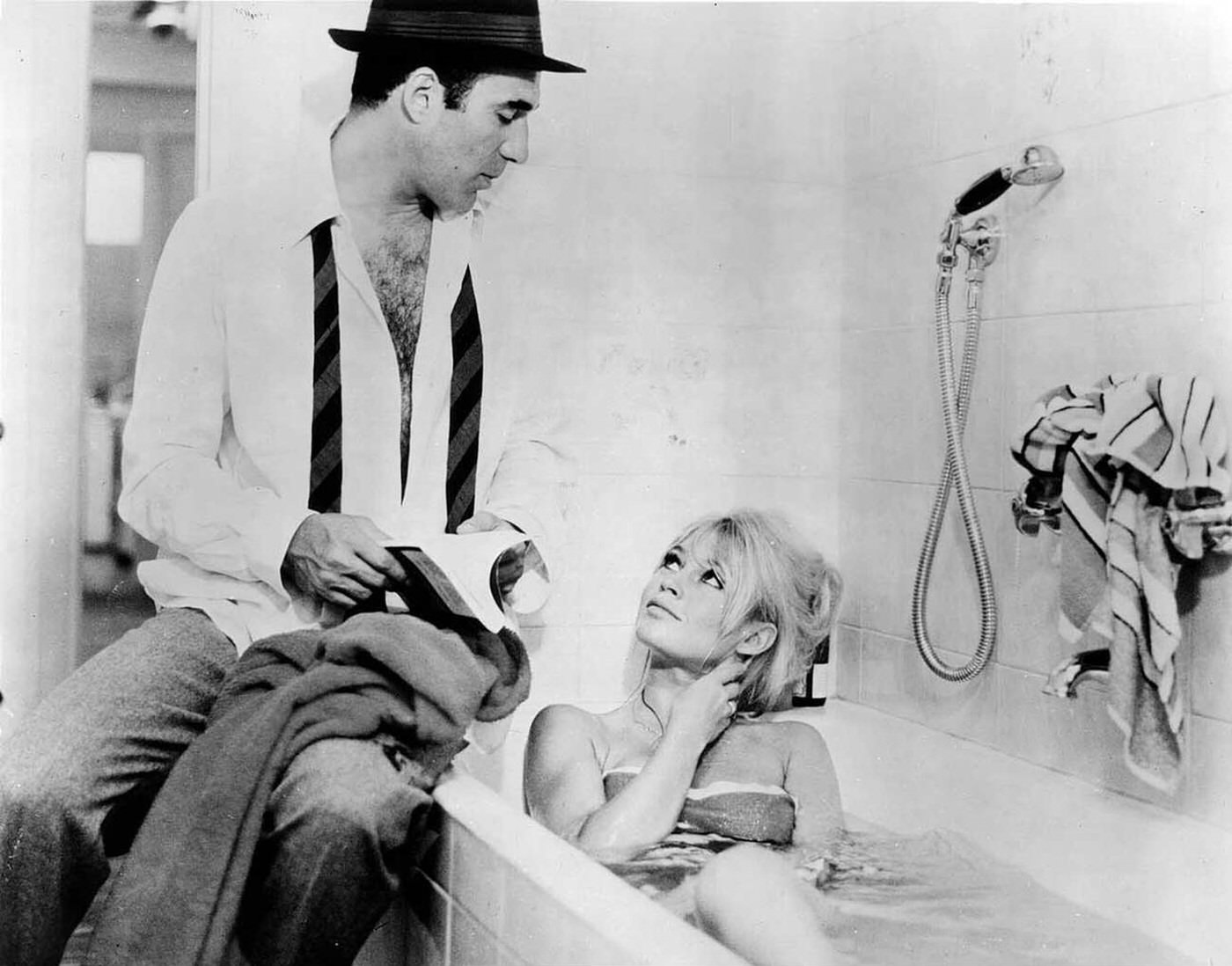
A quiet, charged moment unfolds in a tiled bathroom: Brigitte Bardot reclines in a bathtub, her hair gathered up as she looks toward a man perched on the rim with an open book in his hands. His loosened tie and tilted hat suggest a scene caught between intimacy and interruption, where conversation hangs in the air as much as the steam. Even without dialogue, the composition leans into the emotional distance that makes Jean-Luc Godard’s *Contempt* (1963) so unsettling and unforgettable.
Details in the frame do a surprising amount of storytelling—the handheld shower, the draped towel, the stark white walls, and the cramped angle that keeps the figures uncomfortably close. Bardot’s gaze is the anchor, both direct and questioning, while the man’s attention drifts between the page and the person beside him. It’s a snapshot of mid-century European cinema’s fascination with modern relationships: glamorous on the surface, fractured underneath.
As a historical film still, the image also doubles as an icon of 1960s style and screen presence, with Bardot embodying the era’s blend of vulnerability and celebrity. Fans of French New Wave cinema and classic movies will recognize how Godard turns ordinary interiors into psychological stages, using everyday objects to sharpen the drama. For anyone browsing Movies & TV history, this photograph offers a compact visual summary of *Contempt*: desire, misunderstanding, and the cold clarity of a room too bright to hide in.