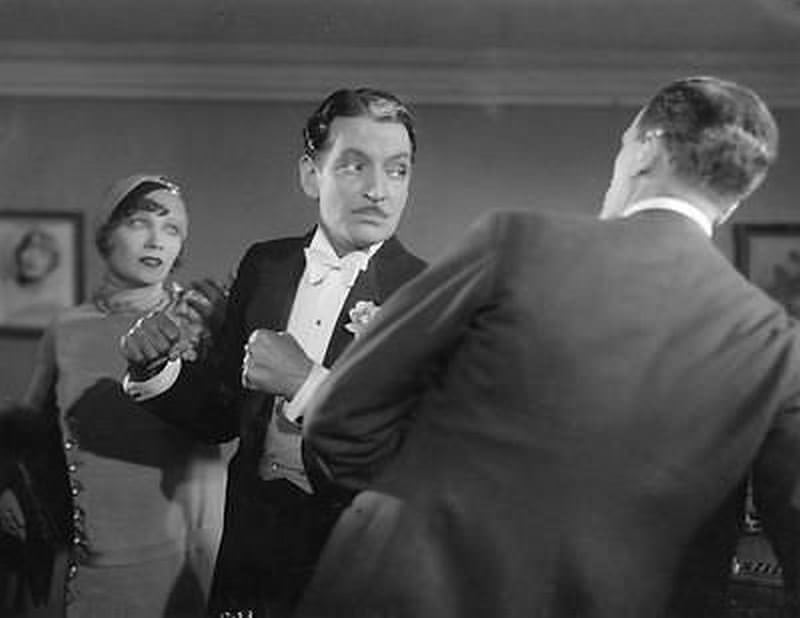
Tension hangs in the air as Gilda Gray, Cyril Ritchard, and Jameson Thomas share a charged moment from *Piccadilly* (1929), with a sharp turn of the head and clenched hands suggesting confrontation just off the edge of civility. Evening wear and poised body language place the scene in a world of nightlife and social performance, where status is signaled as much by posture as by wardrobe. The camera’s tight framing pulls the viewer into the drama, turning a private exchange into something almost theatrical.
Cyril Ritchard stands at the center in formal dress, caught between two forces: the man in the foreground leaning in, and Gray in the background watching closely, her expression alert and knowing. That triangular arrangement gives the still its narrative power, hinting at jealousy, rivalry, or a deal going sour without needing a single line of dialogue. Even in a static image, the scene carries the kinetic energy typical of late silent-era cinema, when gesture and glance had to do the heavy lifting.
Released in 1929, *Piccadilly* sits at a fascinating crossroads, where silent film style met the changing tastes of a modern audience, and stars like Gilda Gray helped define screen glamour. For collectors and film historians, images like this offer more than nostalgia—they preserve the textures of an era, from tailoring and hair fashion to the stage-like blocking that shaped early movie storytelling. As a piece of Movies & TV history, this still invites a closer look at performance, persona, and the drama of London nightlife as imagined on film.