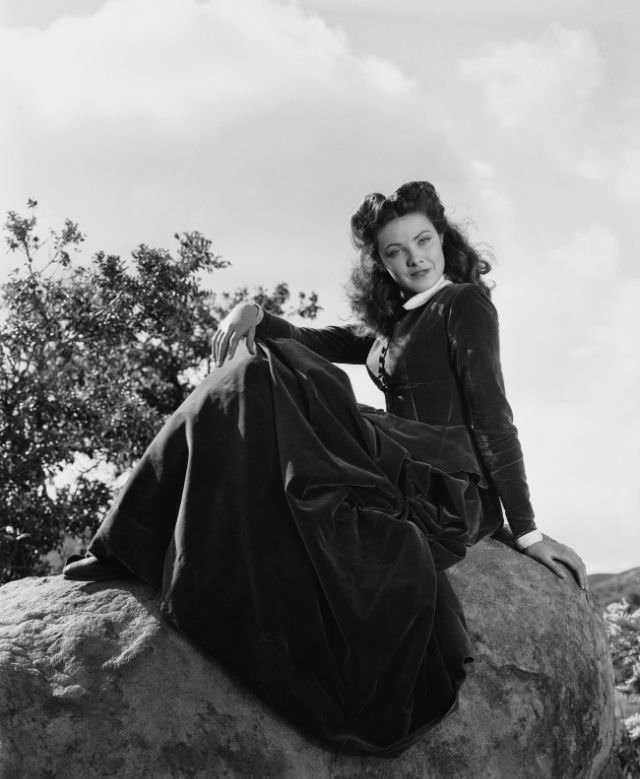
Poised on a sunlit boulder beneath a wide, clouded sky, Gene Tierney projects the kind of effortless confidence that made Hollywood’s frontier fantasies feel alive. Her dark, flowing costume—part gown, part riding-ready silhouette—reads as Western romance rather than grit, with careful tailoring and dramatic drape doing as much storytelling as any prop. The soft outdoor backdrop and low angle lend the portrait a heroic, larger-than-life aura suited to a leading lady.
In “Belle Starr,” the camera leans into contrast: refined elegance set against rugged landscape, a classic 1940s studio strategy for selling adventure with glamour. Tierney’s composed expression and sculpted hair signal star power, while the seated pose on rock suggests a character who belongs to the wilderness on her own terms. Even without action on screen, the still evokes the era’s taste for mythic Americana and boldly framed femininity.
For fans of classic Movies & TV, this image works as both a collectible publicity still and a snapshot of how Western heroines were marketed in the early 1940s. It’s an inviting entry point for readers searching for Gene Tierney, “Belle Starr,” and the visual language of old Hollywood Western cinema—where costume, posture, and landscape combined to build legend. Look closely and you can almost hear the studio-era promise: romance, danger, and a star who commands the horizon.