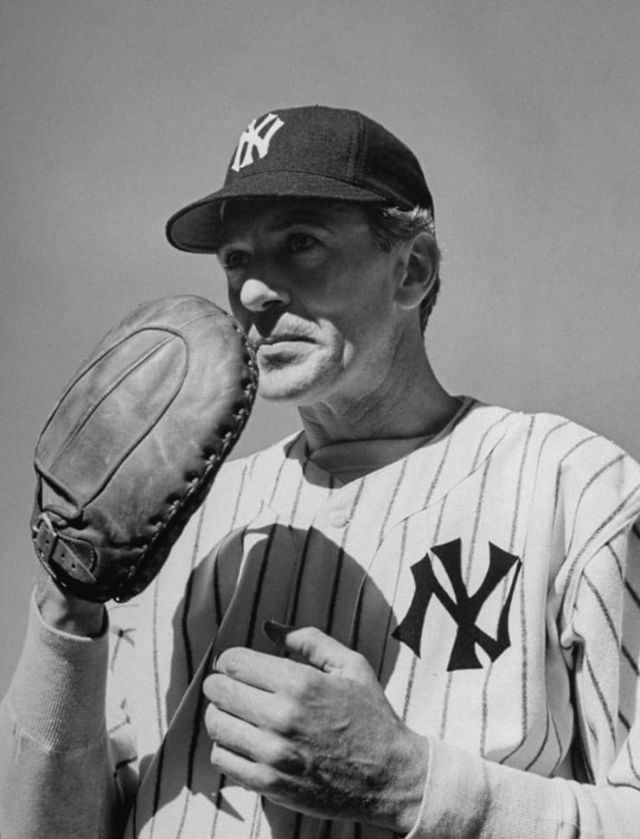
Gary Cooper appears here in a New York Yankees uniform, glove raised near his face as if pausing between plays, the pinstripes and interlocking “NY” doing much of the storytelling on their own. The close framing invites you to study the performance details—how an actor wears a ballplayer’s seriousness—while the bright, open sky behind him keeps the mood clean and iconic. It’s the kind of studio-era publicity still that feels both staged and strangely intimate, a snapshot of Hollywood trying to look like the ballpark.
Released in 1942, The Pride of the Yankees helped cement Lou Gehrig’s legend for movie audiences, blending America’s love of baseball with the era’s appetite for inspirational biography. Even without a stadium in view, the equipment and uniform signal the film’s careful construction of authenticity: a star athlete translated into cinematic language through posture, costume, and light. For anyone searching classic baseball movie history, this image stands as a reminder of how the big screen reshaped sports memory—turning a career into a narrative built for replay.
Alongside its appeal for fans of vintage Hollywood and Movies & TV ephemera, the photo offers a doorway into broader questions about mythmaking, heroism, and the relationship between real life and screen life. Collectors and historians alike can read it as a cultural artifact from the Golden Age of cinema, when publicity photography aimed to sell not just a film but a feeling of national identity. Whether you’re revisiting The Pride of the Yankees or discovering it for the first time, the still underscores why Gehrig’s story—filtered through Gary Cooper’s eyes—continues to resonate.