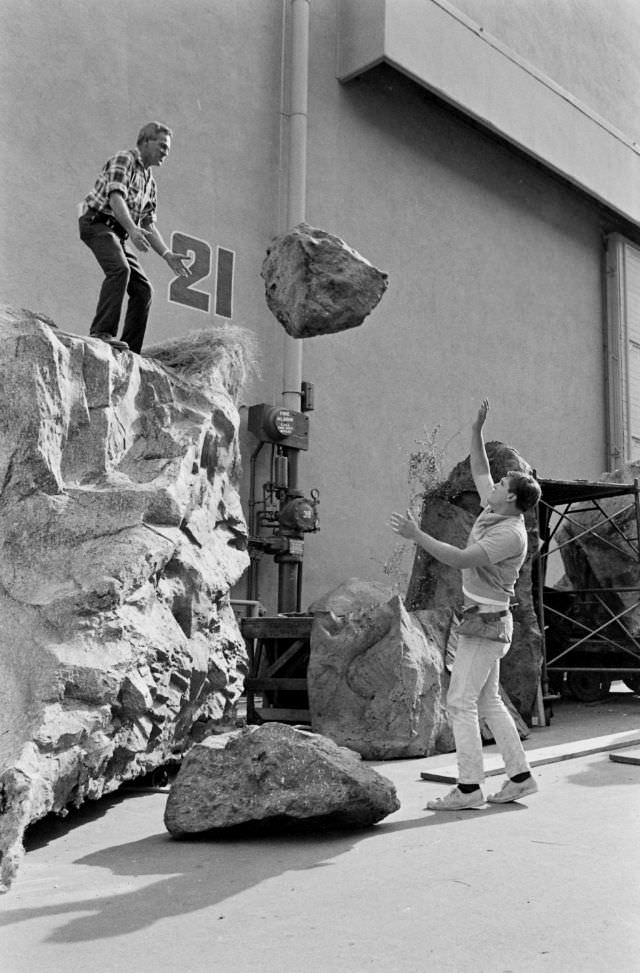
Midair, a “boulder” hangs for a split second between two working hands, turning a studio yard into a playful physics lesson. One prop man balances on an oversized rock façade while another reaches up to receive the flying chunk, their casual clothes and confident posture underscoring how routine this kind of illusion had become. Behind them, the plain industrial wall of the Universal studio lot in Hollywood—marked with a bold “21”—grounds the moment in the everyday infrastructure that made movie magic possible.
Rubber and paint did the heavy lifting in 1960s effects work, and the image is a neat reminder that spectacle often started with something lightweight and practical. The scattered faux stones, the ladder-like rigging, and the hard shadows on the pavement suggest an active work area where sets were assembled, tested, and reset again and again. It’s the unglamorous side of Movies & TV: craftsmanship, safety, and problem-solving, performed in plain view before the cameras ever rolled.
Viewed today, this 1963 snapshot reads like a behind-the-scenes postcard from an era before digital composites, when believable danger depended on materials you could toss and catch. The humor of the scene—two grown men lobbing a rock that isn’t a rock—only sharpens the respect due to the crews who engineered convincing worlds on tight schedules. For anyone interested in Universal Studios history, classic Hollywood production, or practical special effects, the photo offers a crisp, human-scale glimpse of how illusion was built one prop at a time.