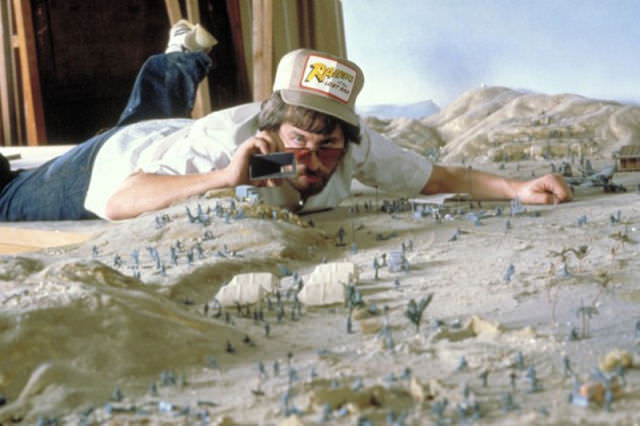
Spread out across a tabletop landscape of dusty hills and tiny figures, Steven Spielberg appears fully absorbed in the practical craft of moviemaking, camera held low to meet the miniature world at its own horizon line. The scene emphasizes how directors and effects teams once relied on hand-built models to create scale, distance, and danger long before digital tools became the industry’s default. Even the casual cap and close-to-the-ground posture suggest a working set where imagination is measured in inches and framed to feel enormous on screen.
From this angle, the miniatures read like a complete environment—ridges, scattered structures, and clusters of small, uniform figures arranged with purposeful spacing. Photographing models demands a particular kind of patience: lighting must mimic natural sun, textures must sell the illusion, and the lens must avoid betraying the true size of the materials. The image invites a closer look at the details that make practical effects convincing, turning a workshop table into a believable battlefield or frontier.
Behind the glamour associated with Hollywood, moments like this reveal the tactile problem-solving that shaped classic Movies & TV production. Miniature photography bridges craftsmanship and storytelling, where a slight shift of perspective can transform foam, paint, and plastic into a sweeping cinematic vista. For anyone interested in film history, Spielberg’s hands-on setup offers a vivid reminder that movie magic often begins with real objects, real light, and a director willing to get down in the dust to find the shot.