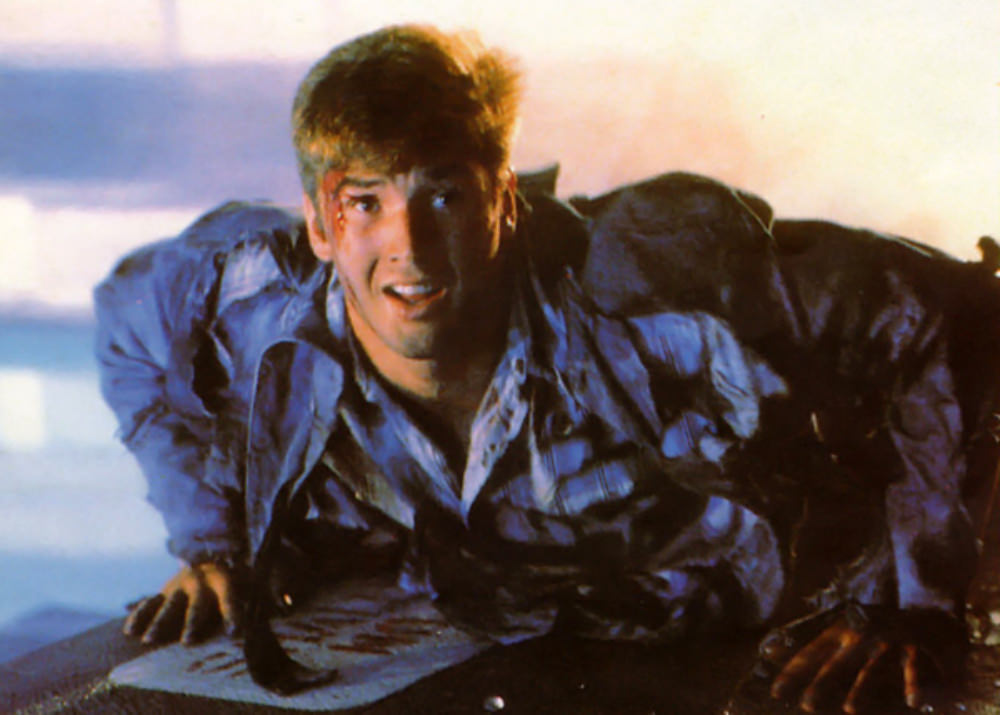
Under harsh, dreamlike lighting, a young actor braces himself on a slanted surface, his expression caught between strain and adrenaline as if the set itself is tilting out from under him. The blue-gray costume reads like something built for impact—rumpled, padded, and meant to sell the illusion of a body being thrown around by forces the camera never quite explains. Even without context, the frame carries that late-’80s horror sheen: high contrast, theatrical color, and a sense that reality is only temporarily holding.
Behind-the-scenes moments from *A Nightmare on Elm Street 5: The Dream Child* (1989) remind us how much of Freddy’s nightmare world was engineered by hands-on craft rather than pixels. Shots like this suggest a practical rig at work—angled platforms, carefully placed grips, and a performer posed to make gravity look unreliable. It’s the kind of production still that invites you to imagine the crew just outside the frame, resetting marks, adjusting gels, and preparing for another take where chaos has to look effortless.
For fans of classic horror movies and 1980s film production, this photo is a small window into the physical labor of making surreal terror feel tangible. The movie’s dream logic depended on lighting, staging, and in-camera tricks that could be repeated reliably under studio pressure. As a piece of *A Nightmare on Elm Street 5* memorabilia, it captures the human side of the franchise—sweat, timing, and teamwork hidden beneath the finished scares.