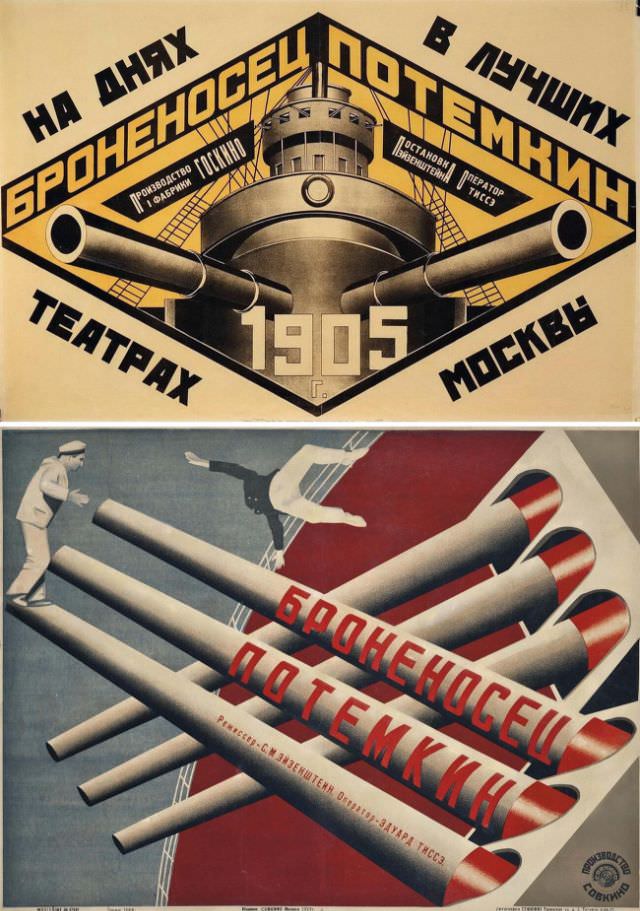
Bold Cyrillic lettering slices across a monumental battleship, its turrets thrust forward like a proclamation rather than a mere machine. The design compresses steel, geometry, and urgency into a single frame, with “1905” planted at the center as an unmistakable historical reference. As a promotional image for *Battleship Potemkin* (1925), directed by Sergei Eisenstein, it advertises not just a film but a mood—defiant, modern, and loud.
What stands out is the way propaganda-era graphic language becomes cinema’s ally: sharp diagonals, oversized typography, and an almost architectural symmetry that turns the warship into an icon. In the lower portion, barrel-like forms converge over a red-and-white field, suggesting motion and confrontation even without a moving picture. It’s a striking reminder of how early Soviet poster art helped shape the visual identity of silent film, merging avant-garde design with political storytelling.
Collectors and film historians often seek out materials like this because they reveal how *Battleship Potemkin* was positioned to audiences—epic scale, revolutionary energy, and a focus on collective force. For a WordPress post about classic movies and TV history, this image adds instant SEO appeal with keywords like Eisenstein, 1925 cinema, Soviet film poster, and Battleship Potemkin artwork. Whether you’re studying graphic design, silent cinema, or the cultural currents of the early twentieth century, it’s hard to look away from a composition built to command attention.