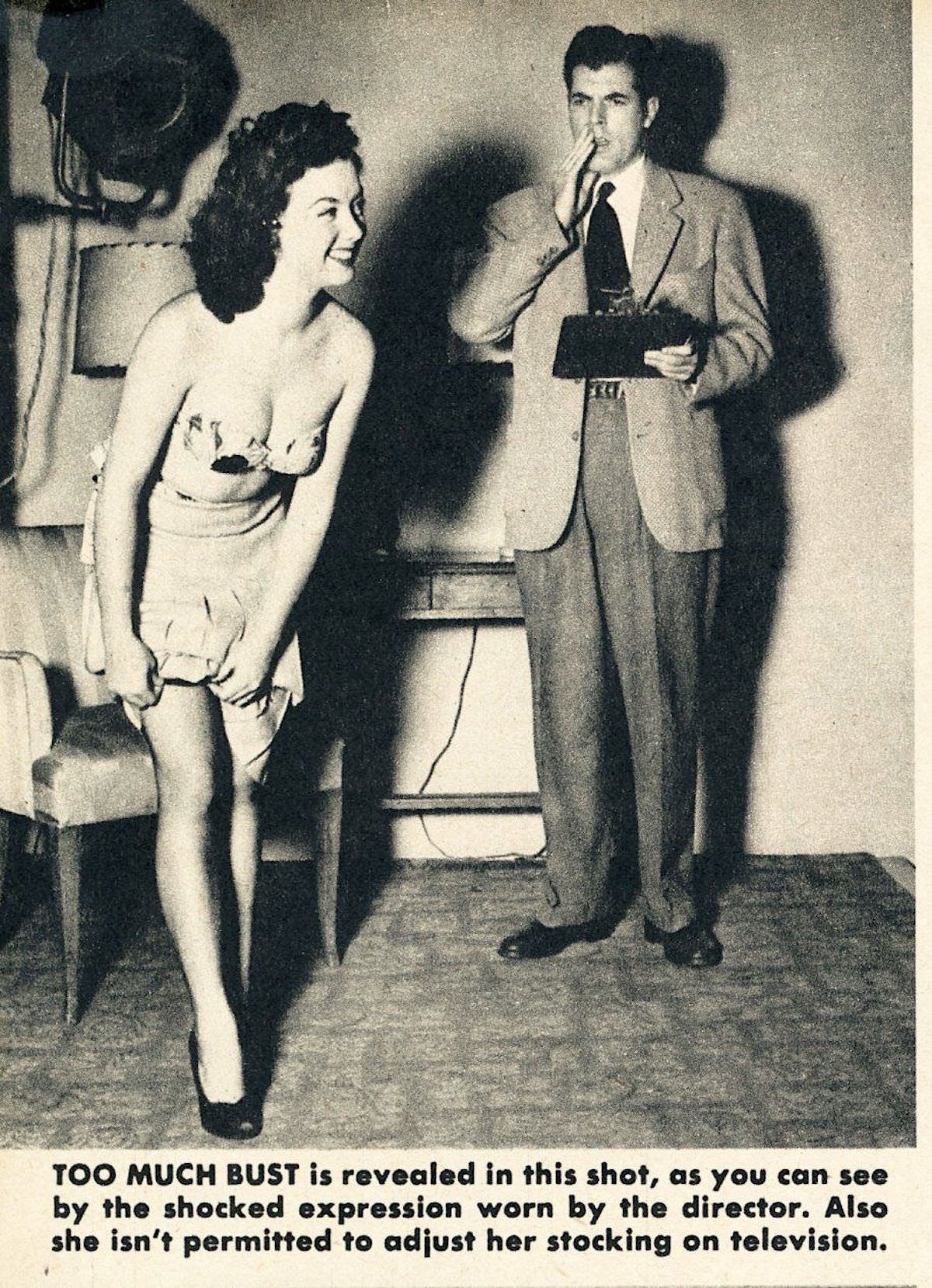
A staged moment from the worlds of movies and television plays out like a cheeky behind-the-scenes gag: a smiling performer leans forward in a revealing costume while a suited man—posed as a director—covers his mouth in mock shock, clipboard in hand. Studio lighting throws hard shadows on the plain wall, and the sparse set dressing (chair, lamp, and a tangle of cord) hints at a small production space where the camera is just out of frame.
The caption at the bottom spells out the joke with the bluntness of mid-century publicity copy, invoking a “too much bust” rule and even policing whether she’s “permitted” to adjust her stocking on television. That kind of manufactured outrage points straight to the era’s obsession with broadcast standards, censorship, and “decency” codes—rules that were often as performative as they were restrictive, and frequently used to sell a wink-and-nudge story to the audience.
What makes this historical photo so telling isn’t only the costume, but the power dynamic it advertises: the industry framing a woman’s body as both spectacle and problem, then packaging the “rule” as entertainment. For readers interested in classic Hollywood, early TV culture, and the history of screen censorship, the image serves as a compact snapshot of how humor, regulation, and publicity worked together to shape what viewers were allowed to see—and what they were encouraged to talk about afterward.