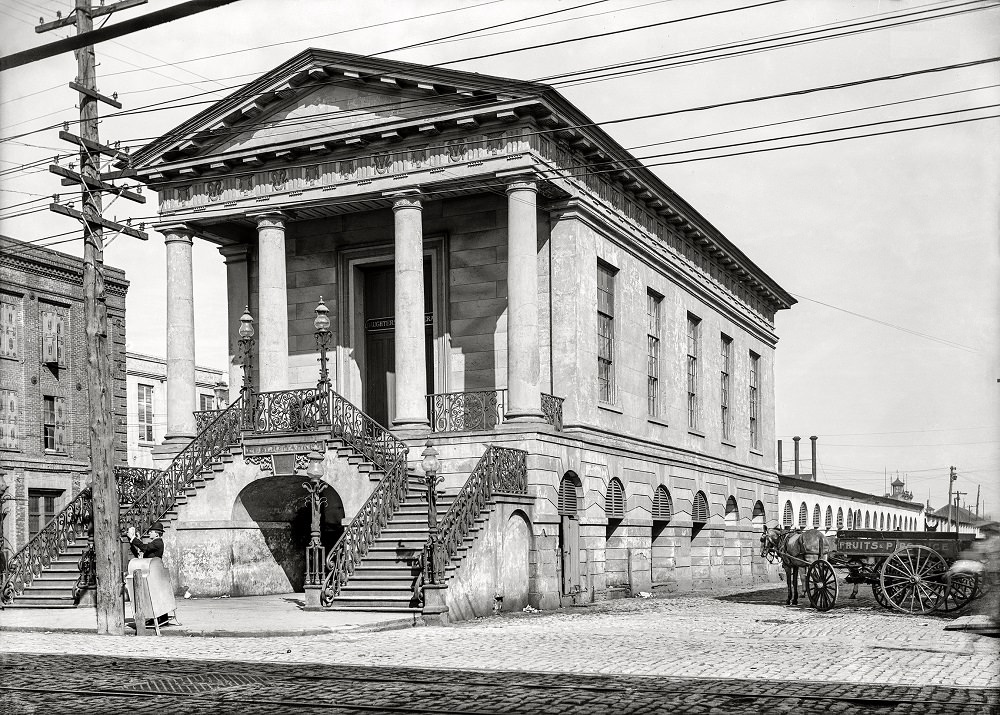
Meeting Street’s Old Market House rises with the confidence of a civic landmark, its classical columns and broad pediment turning a place of daily commerce into a statement of permanence. Twin staircases sweep up to the entrance, framed by ornate ironwork that hints at Charleston’s long tradition of craftsmanship. Overhead, a web of utility lines cuts across the sky, a quiet reminder that by the early 1900s the city’s historic streets were adapting to modern infrastructure even as older architectural forms endured.
Along the cobblestones, street life gathers in small, telling details: a few figures lingering near the steps, the sturdy rhythm of masonry arches at ground level, and a horse-drawn wagon paused beside the market. The painted lettering on the wagon’s side suggests produce in transit, connecting the building’s formal façade to the practical business of feeding a growing urban population. Light and shadow emphasize the structure’s solid stonework, while the long market sheds stretching into the distance give a sense of how extensive the public market complex was.
For anyone searching for early 20th-century Charleston history, this circa 1906 view of the Public Market on Meeting Street offers more than architecture—it evokes the tempo of a working city. The photograph balances monumentality and everyday routine, where trade, transportation, and pedestrians shared the same narrow corridor of street. As a historical image for a WordPress post, it invites readers to imagine the sounds and smells of the market district, and to trace how Charleston’s preserved streetscapes grew from places like this.