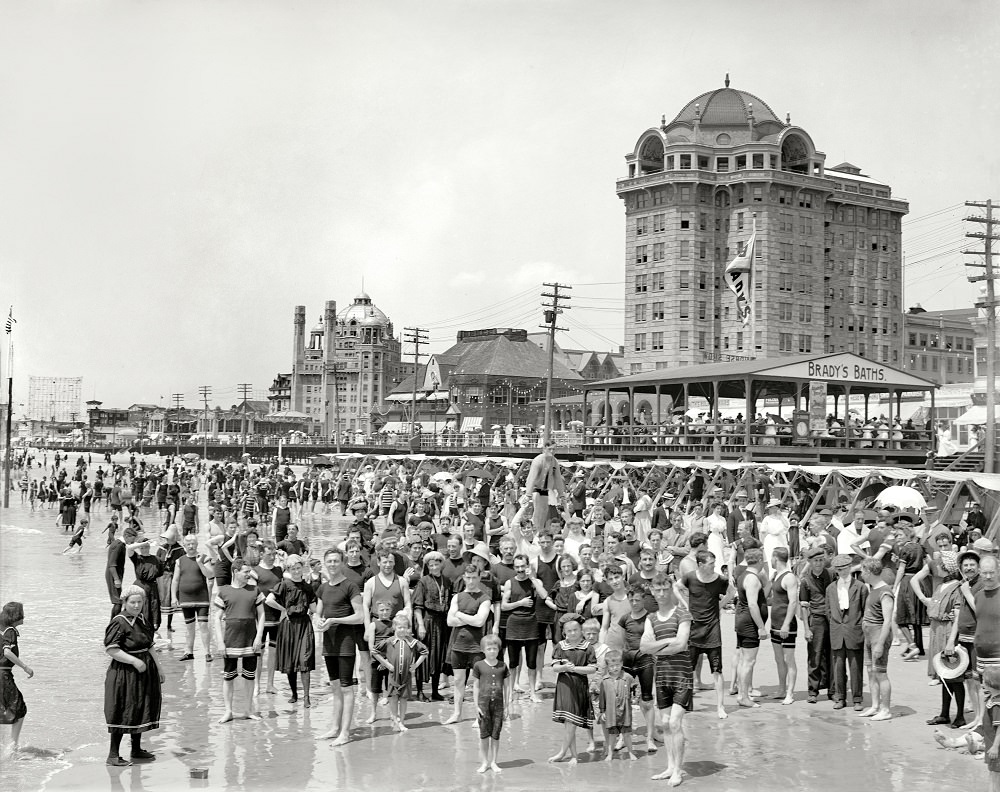
Crowds gather at the water’s edge in Atlantic City, their striped bathing costumes and rolled sleeves turning the shoreline into a lively stage. Men, women, and children wade ankle-deep while others pose firmly on wet sand, faces turned toward the camera with a mix of curiosity and pride.
The density of people suggests a peak-season beach scene, where recreation, fashion, and public spectacle met in full view. Behind the bathers rises a boardwalk world of pavilions, poles and wires, and grand resort architecture that signals a booming seaside city. A sign reading “Brady’s Baths” anchors the scene, hinting at the era’s organized bathing culture—changing rooms, rentals, and the practical infrastructure that made a day at the shore accessible to many. The towering hotel-like buildings in the background add a sense of modern ambition, framing the beach not as wilderness but as an engineered destination.
Taken in 1906, the photograph invites today’s viewer to compare a century of coastal leisure with what remains familiar: the pull of the ocean, the social ritual of strolling and watching, and the desire to be part of a moment worth recording. For readers interested in Atlantic City history, early 20th-century travel, or the evolution of swimwear and boardwalk life, this image offers rich detail in every corner. It’s a bustling snapshot of places and people, poised between an old-fashioned seaside and the modern city it was becoming.