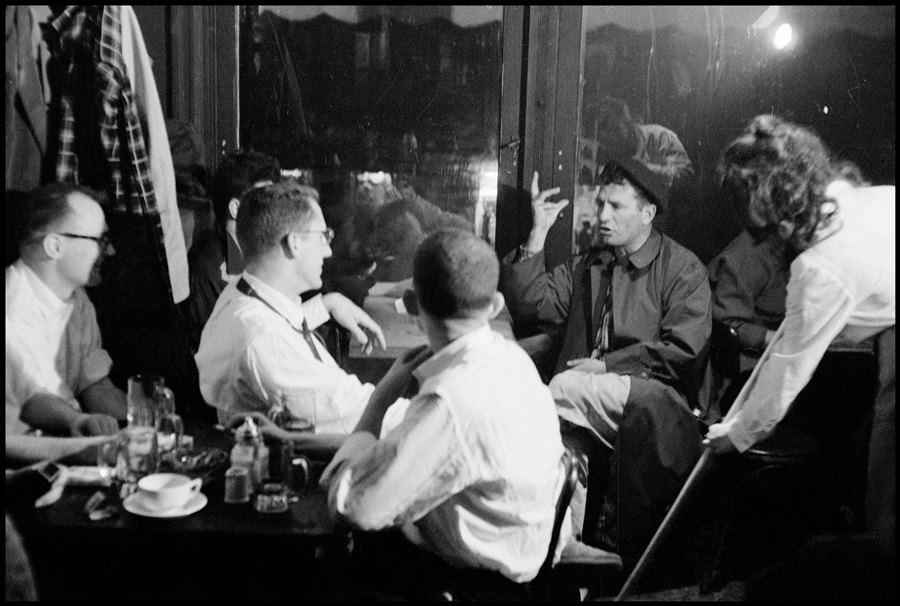
Cigarette smoke, crowded tables, and the glare of streetlight on the front window set the scene at the Seven Arts Cafe in Greenwich Village, where writer Jack Kerouac appears mid-thought, one hand raised as if punctuating a line. Around him, listeners lean in from their chairs, glasses and coffee cups scattered across the tabletop, creating the lived-in feel of a late-night conversation that has outlasted the first round. The composition pulls you into that tight circle, the kind of informal salon where ideas travel faster than the room can contain them.
Kerouac’s posture suggests performance as much as talk—an author “holding court” in the most literal sense, commanding attention without a podium. In 1959, Greenwich Village was a magnet for artists, students, and restless onlookers, and cafes like this functioned as stages for the Beat Generation’s public persona. The photo’s candid intimacy captures how literary culture moved off the page and into nightlife, where storytelling, argument, and improvisation blurred together.
On the page, On the Road had already framed America through a new generation’s hunger for motion, jazz rhythms, and a refusal of polite boundaries; in rooms like this, those themes became social fuel. The small details—the cramped seating, the layered reflections in the glass, the mix of suits and casual shirts—hint at a city in transition and a readership eager to witness its writers in the flesh. For anyone searching Beat history, Jack Kerouac in Greenwich Village, or the cafe culture that shaped mid-century American literature, this moment offers an evocative entry point.